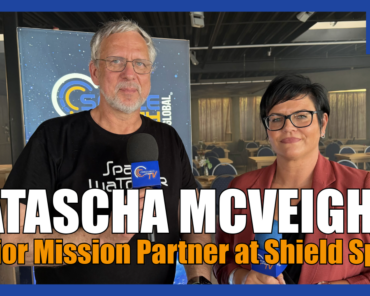
From day one at Mission-K in Kalkar, Torsten Kriening welcomes Jeroen Wink, CRO and co-founder of Dawn Aerospace, into the Space Café studio for a conversation spanning two continents and two distinct product lines.
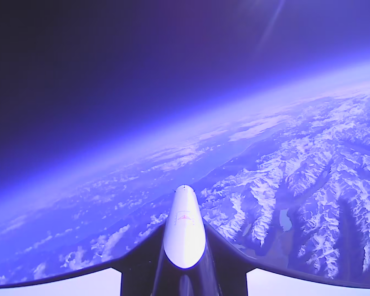
On the New Zealand side sits the Mk-II Aurora, a rocket-powered unmanned aircraft now flying supersonic multiple times a day, both in development and for customers. Much of that work supports defence users with supersonic target presentation, delivered flexibly, safely and rapidly. Turnaround between flights is measured in a few hours – refuel and go again, with no refurbishment required – making several flights in a single day entirely feasible. Wink sets out the roadmap clearly: by this time next year the vehicle should achieve full space flight to 100 km and beyond, approaching hypersonic velocities on both ascent and descent, with an upgraded version flying genuinely hypersonic in 2028 and 2029, serving microgravity research as well as defence use cases made increasingly relevant by the hypersonic weapons threat.

Asked how airspace and regulation are handled at such cadence, Wink explains that in New Zealand the challenge is addressed through certification. The vehicle has been designed to be sufficiently airworthy and is, in all intents and purposes, an aircraft – from detect-and-avoid and ADS-B capabilities through to navigation lights. With that precedent established, Dawn is transferring certification to other jurisdictions, beginning in the United States in 2027 and working toward the Netherlands and France, with Germany a realistic prospect given suitable sites.
On hypersonic threat representation, Wink describes capability already in use. For some customers, Dawn flies the trajectory of the threat to be represented, communicated in advance, allowing a vessel to attempt detection, tracking and trajectory prediction, including through aggressive late-phase manoeuvring. Other exercises involve space-based detection and early warning, where plans are not shared in advance. Such exercises were conducted with the New Zealand Defence Force earlier this year, with comparable activities planned in the US and Europe – all using the vehicle flying today.
In the Netherlands, meanwhile, Dawn’s chemical satellite propulsion – high performance, affordable and readily scalable – flies on more than 55 satellites, including projects for Dutch, US and French defence users, with capabilities now expanding to other European customers. Looking ahead, Wink highlights in-orbit refuelling: a customer launching imminently carries Dawn’s docking and refuelling port, in his understanding the first European satellite designed to be serviceable from day one. That precedes a 2028 in-orbit demonstration of docking and propellant transfer between satellites – turning future spacecraft from expendable to reusable, offering defence users near-unlimited mobility and improving commercial economics through significantly reduced capital expenditure.