From Kalkar on the second morning of Mission-K, Torsten Kriening reviews a dense opening day and sets out what is to come.
Five keynotes opened the event in the historic control room of the decommissioned nuclear power plant. Host Alexander Kleinschmidt, Managing Director of MKS and Mission-K, began with an overview of where things stand, addressing resilient architecture and the actions the sector needs to take. He also used the occasion to announce MKS – Missionskritische Systeme – created to support the armed forces with AI-driven sovereign defence software solutions.

Thomas Tschirner, Head of Defence Programmes at ArianeGroup Germany, followed with a sobering assessment of threats in orbit, describing genuine rather than theoretical risks, including satellites shadowing assets used by the German armed forces. Lieutenant Colonel Michael Frick, liaison officer between the Bundeswehr’s Space Command and DLR, then presented Germany’s approach to providing industry with a clear entry point, the Space Innovation Gateway.
A particularly striking contribution came from Martin Rudolph, Director of Business Development at Stark Defence, who offered a user’s perspective on the war in Ukraine, drawing on the company’s experience with ISR drones and loitering munitions. His message to the space community was unambiguous: give us tactical ISR from space.
The morning closed with a conversation featuring Manouchehr Shamsrizi of the DGAP, the German Council on Foreign Relations, who argued that the story matters as much as the hardware – space defence, he suggested, has a communications problem. It is a challenge SpaceWatch.Global has long worked to address.
The afternoon brought a notably loud rocket engine test conducted by Delta Orbit in front of the reactor building, the opening of the Experience Colony, and an evening Space Café.
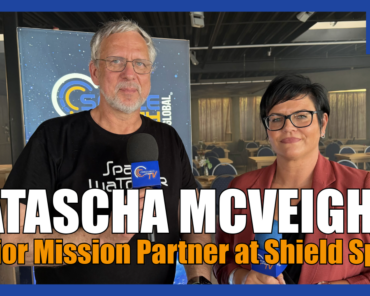
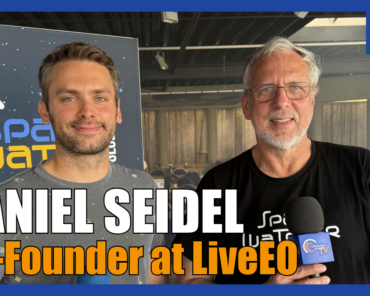
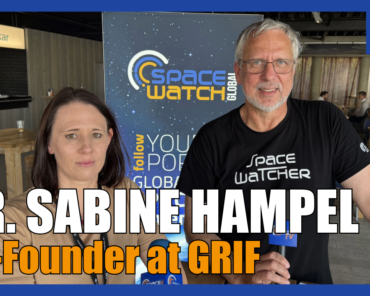
Day two turns to the three Space Defence Challenges, co-formulated with the Bundeswehr Space Command: non-kinetic active defence mechanisms, hosted by ArianeGroup; resilience through high-tech materials and passive protection, hosted by Evonik; and mobile satellite control in contested environments, hosted by Mission-K. Following keynotes and challenge briefings, competing interdisciplinary teams work in parallel before Major General Michael Traut, Commander of the Bundeswehr Space Command, opens the Solutions Pitches in the power plant’s cooling tower. SpaceWatch.Global continues its interviews and reporting from the Experience Colony throughout the day.