Ibadan, 21 October 2026. – UK-based Spaceport Cornwall and aerospace company Dawn Aerospace have signed a memorandum of understanding (MoU) to explore establishing the Dawn Aerospace Suborbital Horizontal UK Launch Programme (DASH UK) at Cornwall Airport Newquay.
The proposed service would use Dawn’s reusable, rocket-powered Aurora spaceplane to offer suborbital flight opportunities for research institutions, commercial customers, and defense organizations, potentially expanding access to high-altitude testing and microgravity experiments.

The agreement brings together Spaceport Cornwall’s airport-based infrastructure and Dawn Aerospace’s approach to reusable, runway-launched spaceflight, establishing a framework for the two organizations to assess the feasibility of UK operations. However, the MoU does not confirm a launch schedule or establish that the service will proceed, with regulatory, operational, and commercial requirements still to be evaluated.
Expanding access to microgravity experiments
Aurora’s practical value lies in its potential to make suborbital research and technology testing more repeatable. Its reusable design could allow researchers and technology developers to conduct successive experiments without relying on a new expendable launch vehicle for each mission. By supporting repeated flights, the spaceplane could consequently help customers test and refine technologies more frequently and shorten development cycles.
Dawn Aerospace lists Aurora’s planned capabilities as reaching altitudes of up to 100 km while carrying payloads of up to 15 kg. Furthermore, its suborbital mission profile is designed to provide up to 127 seconds of microgravity, creating opportunities for experiments and technology demonstrations that require brief periods of reduced gravity. The company also advertises a turnaround time of four hours, a target that could support more frequent testing if achieved in operational service.
“This MoU represents an exciting opportunity to bring a genuinely transformational aerospace capability to the UK. The Aurora spaceplane offers a more responsive and reusable approach to accessing the upper atmosphere and near-space environment, opening new possibilities for research organizations, technology developers, defense users and commercial customers. Together with Dawn Aerospace, we aim to establish Cornwall as the UK’s gateway for routine suborbital flight.”
Supporting UK aerospace research and development
The proposed partnership would build on Spaceport Cornwall’s wider efforts to establish Cornwall as a center for advanced aerospace and future-flight activities. So far, the spaceport has pursued opportunities involving hypersonic flight testing and other emerging aerospace technologies, alongside its existing launch-related infrastructure. If established, DASH UK could add reusable suborbital flights to these activities and attract organizations seeking access to near-space conditions for research and technology development.
The proposed DASH UK program also comes as the UK seeks to strengthen its space sector under the Space Strategy published in September 2026. The strategy identifies access to space as one of four priority subsectors, with an emphasis on developing domestic launch capabilities and securing reliable access to orbit. While Aurora’s suborbital role differs from these orbital objectives, the proposed service could complement the broader UK aerospace ecosystem by supporting technology development, research, and commercial testing.
Pursuing Aurora operations on both sides of the Atlantic
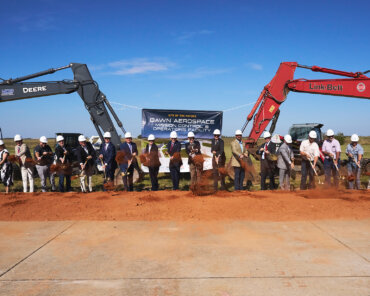
The proposed UK initiative also follows a similar effort in the United States, where Dawn Aerospace is working with the Oklahoma Space Industry Development Authority (OSIDA) to establish Aurora operations at Infinity One Oklahoma Spaceport in Burns Flat. The partnership has progressed to the construction of dedicated infrastructure for the spaceplane, marking a more advanced stage of implementation than the exploratory MoU signed in Cornwall.
Although the two partnerships remain at different stages, they reflect a shared ambition to establish routine suborbital flight operations using existing runway infrastructure rather than conventional rocket launch facilities. Oklahoma has committed public funding to dedicated facilities, while the Cornwall agreement remains an exploratory MoU to assess the operational, regulatory, and commercial requirements for DASH UK.