Ibadan, 4 November 2026. – Thermal satellite imagery company Hydrosat has announced the Nyktòs program, a planned high-resolution thermal imaging capability designed to provide tactical intelligence, surveillance and reconnaissance (ISR) services to sovereign customers. The program will be supported by an expansion of the company’s European technology and manufacturing presence, including a new facility and regional supply-chain partnerships.
The program will focus on developing high-resolution midwave infrared (MWIR) imaging technology for security, intelligence and other government applications, extending Hydrosat’s thermal Earth observation capabilities in the defense and national security market.
Combining broad-area and high-resolution thermal imaging
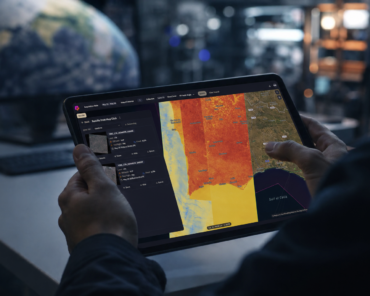
Nyktòs is intended to provide governments with detailed thermal imagery of specific locations, supporting the monitoring of military activity, critical infrastructure and other developments of national security interest. Unlike conventional optical imaging, which relies on reflected sunlight, thermal sensors detect infrared radiation emitted by objects, allowing them to collect imagery during both daytime and nighttime operations.
Hydrosat’s approach involves two complementary thermal imaging capabilities. Its planned Osiris constellation, which was announced on 16 September 2026, will use longwave infrared (LWIR) sensors to monitor temperature patterns across areas as wide as 340 kilometers with a 25m resolution, while Nyktòs is being developed around midwave infrared (MWIR) technology to capture higher-resolution images of smaller locations. Together, the two capabilities are intended to combine broad-area monitoring with more detailed observations of specific sites.
The two systems will support a process known as tipping and cueing. Under this approach, Osiris could identify unusual thermal activity across a large area and cue Nyktòs to collect more detailed imagery of the location. For example, changes in temperature patterns around a military installation or industrial facility could prompt a closer observation, helping analysts investigate the activity.
“Finding and understanding activity on the ground requires both monitoring of wider areas and the ability to examine specific locations in detail. Broad-area thermal monitoring provides the context to identify changes, while high-resolution MWIR allows us to investigate those changes more closely,” explained Scott Soenen, Chief Technology Officer at Hydrosat.
“Our vision is to bring these complementary capabilities into a coherent thermal observation system, helping governments and commercial customers understand what is changing, where it is happening and how it fits into the broader picture.”
Expanding European manufacturing and sovereign capabilities
As part of the Nyktòs program, Hydrosat plans to establish a new facility in Europe to support the development and production of its thermal imaging technology. The company also intends to expand its network of regional suppliers and strengthen its European industrial presence, with the planned production site expected to support the manufacture of Nyktòs payloads for government customers.
Hydrosat is still considering potential locations for the facility, which could become operational in 2027, according to CEO Pieter Fossel. The first Nyktòs payloads could come off the production line as early as 2028, while the first two satellites in the planned Osiris constellation are scheduled for launch in 2027.
The European expansion is intended to address governments’ requirements for sovereign access to satellite intelligence. Through dedicated mission arrangements, Hydrosat aims to give customers greater control over satellite tasking, mission operations and access to collected imagery. The company is targeting NATO and allied governments with requirements spanning national security, critical infrastructure monitoring and crisis response.
FPieter Fossel said:
“Europe’s investment in space is an investment in its ability to protect its interests and make independent decisions. We are committed to helping turn that ambition into capability. By expanding our presence and investing in technology development here in Europe, we are strengthening the industrial foundation for sovereign space missions-and for Europe to act with confidence alongside its allies.”
A hybrid model for government customers
For sovereign missions, Hydrosat is proposing a hybrid approach that combines dedicated national capabilities with capacity from its commercial constellation. This would allow governments to tailor satellite observation services to their requirements while drawing on a wider network for additional coverage and more frequent observation opportunities. The model is intended to combine the customization of dedicated missions with the broader observation capacity of a commercial network.
Hydrosat’s expansion comes amid growing European efforts to strengthen strategic autonomy, improve defense readiness and protect critical infrastructure through greater access to space-based capabilities. As governments become more reliant on satellite-derived information for security and crisis response, control over data collection, tasking and access to sensitive information is becoming an increasingly important consideration.