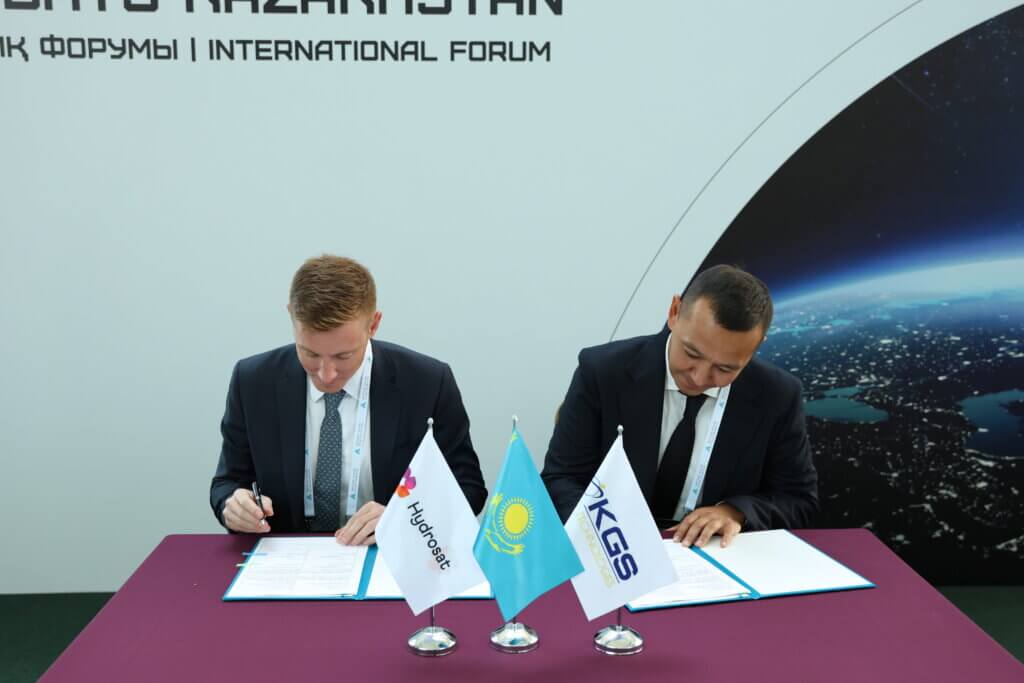
Ibadan, 8 September 2026. – Hydrosat and JSC “NC “Kazakhstan Gharysh Sapary” (JSC “NC “KGS”), Kazakhstan’s national space company, have established a framework to evaluate the development of a dedicated thermal infrared satellite constellation around water security.
Targeting sovereign thermal EO capability

On the basis of a Memorandum of Understanding (MoU), the companies will explore the feasibility of a dedicated national satellite capability to provide thermal data for applications including water and food security, environmental monitoring and critical infrastructure planning.
The initiative builds on the companies’ earlier cooperation on satellite-based water intelligence and intends to provide a foundation for expanding thermal Earth-observation capabilities across Kazakhstan and Central Asia.
The collaboration also reflects Hydrosat’s expanding role from a thermal satellite data provider to a partner supporting governments in establishing long-term strategic Earth observation capabilities through national Earth observation missions.
“For Kazakhstan, the sustainable and efficient use of water resources and the adoption of advanced technologies for their monitoring are of strategic importance. Our partnership with Hydrosat opens up new opportunities for the use of thermal satellite data and lays the conceptual foundation for a future satellite constellation tailored to the needs of Kazakhstan and the countries of Central Asia,” said Kaiyrzhan Kozhayev, Chairman of the Board of JSC NC “KGS.”
Addressing water-security challenges in Central Asia
Climate pressures, aging infrastructure and growing competition for shared water resources, amidst other factors, have seen reliable access to water become a strategic national priority. In particular, water security is critical to food production, economic resilience, energy generation and regional stability across Central Asia. This has consequently driven institutional interest in dedicated satellite capabilities to facilitate the effective management of critical national resources through timely independent intelligence.
Furthermore, thermal infrared observations enable land surface temperature and evapotranspiration measurements. These measurements help identify irrigation inefficiencies, drought conditions, and environmental change, as well as monitor crop water consumption, providing insights that complement conventional optical imagery.
“Water security has become fundamental to national resilience,” said Pieter Fossel, Chief Executive Officer of Hydrosat. “Governments need trusted, independent information to make decisions about critical resources and economic stability. Together with Kazakhstan Gharysh Sapary, we’re working to develop dedicated thermal satellite capabilities that can provide that intelligence while strengthening long-term national capacity.”
Evaluating pathways towards a sovereign satellite constellation
Access to reliable and trusted Earth observation data has become an essential element of national infrastructure, with governments investing in national satellite capabilities that reduce dependence on external data sources.
Reflecting this global shift and building on their earlier collaboration, the MoU will see Hydrosat and KGS evaluate technical, operational, and commercial pathways for a sovereign thermal infrared capability while supporting wider regional priorities around water security, environmental stewardship, and digital infrastructure.