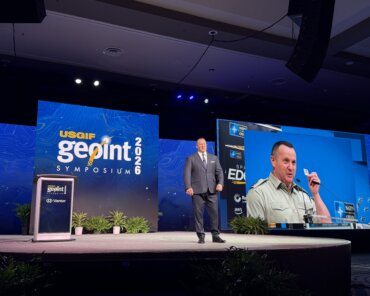
At GEOINT 2026 in Aurora, Colorado, Torsten Kriening spoke with Amanda Fetch, fresh off completing her PhD and returning to the conference where she had presented as a poster participant just a year earlier.

Her focus has not changed. The scale of the debris problem has.
Current estimates point to tens of millions of fragments in orbit, most too small to track individually but large enough to damage or destroy satellites. At the same time, the total mass of debris has increased sharply, while the number of active satellites continues to climb.
Instead of approaching this as a purely sensing problem, Fetch treats it as a data challenge.
Her work applies machine learning to identify patterns in orbital behavior, grouping debris into clusters based on shared characteristics. The goal is not to track every object individually, but to make the overall environment more manageable. By reducing complexity early, conjunction analysis can focus on what actually requires attention.
That matters because current systems were not built for the scale that is coming. Thousands of objects are one thing. Millions are another.
The question of responsibility remains open. Military, civil, and commercial actors all play a role, but coordination is still evolving. Meanwhile, the impact is no longer abstract. Communication, navigation, and infrastructure all depend on stable orbits.
The difficulty is that most of this remains invisible to the public.
Which may be part of the problem.