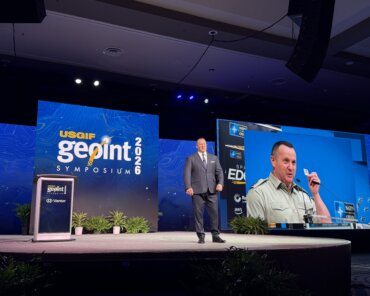
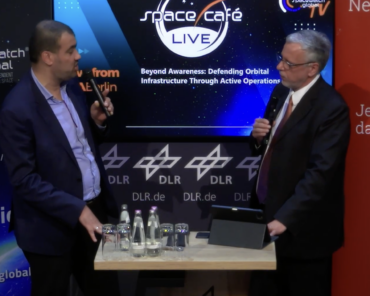
At GEOINT 2026 in Aurora, Colorado, Torsten Kriening spoke with Pino Nobile, who leads the GEOINT and Space Services Section at NATO headquarters.
His role sits at the intersection of intelligence production and decision-making. GEOINT products are not only delivered to military leadership, but increasingly to political decision-makers and a broader intelligence ecosystem that depends on consistent, reliable outputs.

That context shapes how NATO approaches new technologies.
Artificial intelligence is already part of the conversation, but not in the way often seen elsewhere. For Nobile, the issue is not whether AI should be used. At the scale NATO operates, ignoring it is not an option.
The question however is, how to best control it.
Policies, governance frameworks, and security requirements are treated as prerequisites rather than afterthoughts. AI may accelerate analysis and decision cycles, but it also introduces new dependencies and risks. For an organization operating across multiple nations, alignment matters as much as capability.
Nobile’s perspective is shaped by nearly three decades within NATO.
He notes that the organization is moving faster than it used to, particularly when it comes to implementing policy and adapting to new operational realities. Lessons from recent conflicts, including Ukraine, are feeding directly into this process, with dedicated structures now in place to capture and apply them.
Nevertheless, the role of space remains foundational.
GEOINT depends on space-based sensors, and NATO’s investments in this domain continue to grow, including through dedicated facilities such as the NATO Space Centre in Ramstein. Without these capabilities, many modern operations would not be possible.
This dependency adds another layer to the AI discussion.
Faster data processing and decision-making are valuable, but only if they remain secure, controlled, and trusted across all member states.
At NATO, that balance is not theoretical, but rather operational.