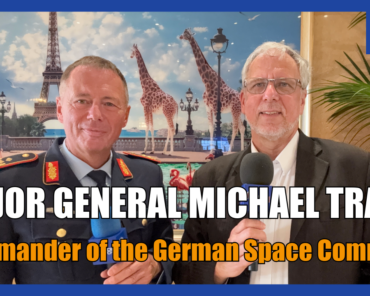
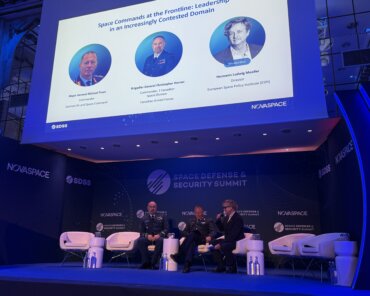
“Catalogued and controlled?” On Day 2 of ILA 2026 in Berlin, a Space Café “33 Minutes With…” panel hosted by Torsten Kriening (SpaceWatch.Global) and Nicola Kuhrt (Space.Table) examined the situational picture in orbit from three angles — the military mission and the commercial cutting edge. The panel brought together Major General Michael Traut, Commander of German Space Command; Kristina Nikolaus, CEO and Co-Founder of OKAPI:Orbits; and Prof. Chiara Manfletti, CEO of Neuraspace and professor at the Technical University of Munich.

Traut was candid that Europe remains far from a fully “Recognised Space Picture”: revisit rates run from hours to days, while mega-constellations and deliberately maneuvering satellites — including “shell games” in geostationary orbit — make objects hard to track. More sensors and far higher sensor density, he argued, are unavoidable, as are algorithms. Nikolaus and Manfletti agreed the physical objects are the same; the value lies in interpretation and in operationalising the data for each use case, with AI increasingly able to predict where an object will be after a manoeuver.
The discussion turned to collision avoidance in an orbit with no traffic rules, the limits of the “contact book” when uncooperative actors don’t answer, and the need for international “rules of the road.” Manfletti made the case for governments becoming customers of industry, sketching an integrated German offering combining Vyoma, OKAPI:Orbits and Neuraspace. Traut drew a hard line at the state’s monopoly on force, while leaving room for deep commercial-state cooperation.
Asked what is really breaking Europe, the panel pointed not to money or competence but to a decades-old risk-avoidance culture — and the urgent need to accept risk, move faster and prepare for exponential growth.