Berlin, 17. February 2025. – The German industry information service “Klartext Raumfahrt” – KTR for short – is known for its clear criticism of institutional structures and projects of the EC in particular. Recent articles and comments from the medium, which focuses in particular on the EU’s dealings with space SMEs and start-ups, have caused a stir with the message: Europe is keen to follow in large footsteps instead of leading with its own, while at the same time managing to complain about the supremacy of SpaceX and Elon Musk in particular. Because, according to Klartext Raumfahrt, it is precisely in the really large and correspondingly expensive projects that it becomes clear how much Europe is looking to American role models and, even as it imitates them, wants to challenge their leadership position – an approach that defies all logic and is doomed to failure.
KTR illustrates this with two particularly outstanding examples.
Number 1: Launchers. Contrary to all the promises and forecasts of the responsible industry made during the long period of its development, Ariane 6 has neither economically matched the competitiveness of Falcon 9 nor technically matched its reusability and achievable launch frequency per launcher per year; but, even if it had succeeded in doing so, it would at most have been able to catch up, not take the lead. In addition, KTR shares its observation with readers that Europe appears to be implementing the tendency to follow even when the American example has long since shown that a particular path will not bring success. In this case, we are talking about the development of small launchers, which has been increasingly promoted by the government; the name of the program in the USA was “DARPA Launcher Challenge”, followed years later now by the European version under the title “European Launcher Challenge”. In the end, the American example showed that the small launchers had no chance against a Falcon9 reconfigured as a “large-capacity cab” for many payloads. According to Klartext Raumfahrt, Peter Beck’s RocketLab merely took the opportunity to establish itself in a small niche of the market, while all others like the “Pegasus” small carrier by Northrup Grumman disappeared.

Number 2: Iris2 versus Starlink. The German media consistently take the view that Iris2 is Europe’s answer to Starlink and an attempt to break Starlink’s monopoly position. Simply a case of megalomania? Starlink is a thoroughly commercial company with a special “Starshield” capacity reserved for American government purposes, but Iris2 is, according to KTR, a primarily institutional product whose already limited commercial capacities (probably just 10 Satellites on 750 km LEO) are just the icing on the cake for the people, but which is immediately cut off as soon as Brussels officials start to suffer from stuttering video playback. In other words, a half-hearted attempt is being made to copy Starlink in its flagship area of commercial service with a product called Iris2, which as an institutional tool is the exact opposite of Starlink. This is another KTR-example of the Europeans’ nonsensical tactic of following instead of leading and then seeing this as the way to the top.
But how do you really get there?
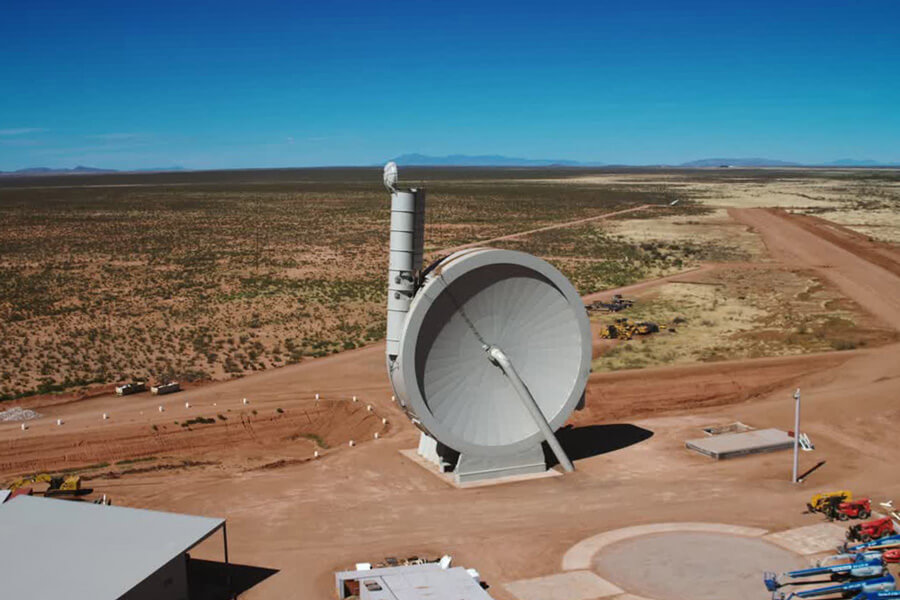
KTR provides an example with the report on the Californian start-up “SpinLaunch”. A satellite slingshot with enormous kinetic energy is to provide a far more cost-effective and environmentally friendly alternative to conventional launch vehicles on the commercial launch market by 2026. Inventing such a concept and then actually implementing it requires one thing in particular, which the great pioneers of groundbreaking developments – whether Jules Verne, David Wrenn as CEO of SpinLaunch or Elon Musk – all possess or have possessed in abundance: AI’s counterpart, Natural Intelligence (NI). In contrast to AI, which relies on data mining in the past for all its operations – even when it comes to predicting the future – NI is the ability to question the past and the established and to completely rethink solutions from scratch.
In the firm belief that there are still immeasurable treasures to be unearthed in the concentrated search for NI-generated new solutions, the Editorial Board of SpaceWatch.Global has decided to launch the “Natural Intelligence Competition for really disruptive ideas in spacetech” and to encourage space enthusiasts around the world to present the lever with which they want to unhinge the world. Want to join in? Nothing could be simpler: tell us the space technology you want to replace – for example, launch vehicles – and present your idea and technology for it. We will let the rest of the world participate in the fruits of your genius: immediately, thoroughly, respectfully.
Senior Editor Franz P. Spaunhorst of SpaceWatch.Global looks forward to receiving your e-mail at: senior.editor (at) spacewatch.global