Written by Novi Dewan

In November 2021, a Russian missile blasted one of its own satellites, Cosmos-1408, into more than 1,500 trackable fragments and countless smaller splinters. Within hours, astronauts aboard the International Space Station were forced to take cover.
The physics was inevitable, the lesson still stings: debris creates more debris, the clock on orbital safety is ticking and space still has no cleanup crew.
It is a stark reminder that space remains a frontier without borders, but not without consequences. And the need for coordination has never been greater.

Paris convenes the doers
This year’s Summit for Space Sustainability, held in Paris on October 22–23, reinforced the shared notion that governments, operators, and international bodies face the same imperative: coordination of outer space activities before crisis. It was a fitting venue for a meeting that blended policy, engineering, economics, and law into one stubborn question: how do we keep space safe and usable?
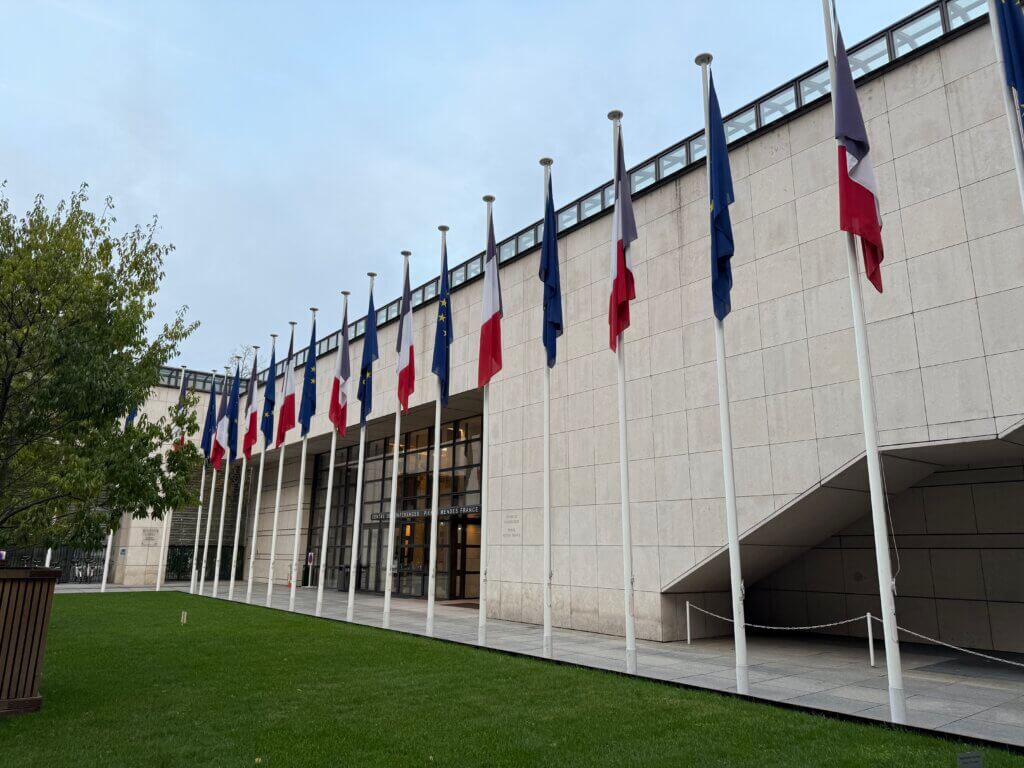
The Summit, organized by the Secure World Foundation in partnership with France’s Ministry of Economy, Finance and Industrial and Digital Sovereignty and CNES (Centre National d’Études Spatiales), France’s national space agency, brought together heads of agencies, CEOs, mission designers, lawyers, economists, and practitioners who actually fly and fix things.
In the corridors and from the stage, the voices were diverse: satellite operators and launch providers, national space agencies and regulators, professors and students, startups building SSA and SDA tools, lithium-battery providers and life-cycle assessment experts, and yes, even a fashion entrepreneur plotting a vintage-clothes platform who came for inspiration. It was that kind of week, cross-pollination by design.
Laying the foundation
We heard Peter Martinez (Secure World Foundation) frame it with a cinematic wink, watching 2001: A Space Odyssey en route to Paris, then drop us back into 2025 reality: space is congested (crowded with satellites), contaminated (with debris), and contested (by competing actors with divergent incentives). The mission is as prosaic as it is urgent: safe, secure, and sustainable space, so that agriculture, shipping, emergency services, climate monitoring, and communications keep working quietly in the background of daily life.
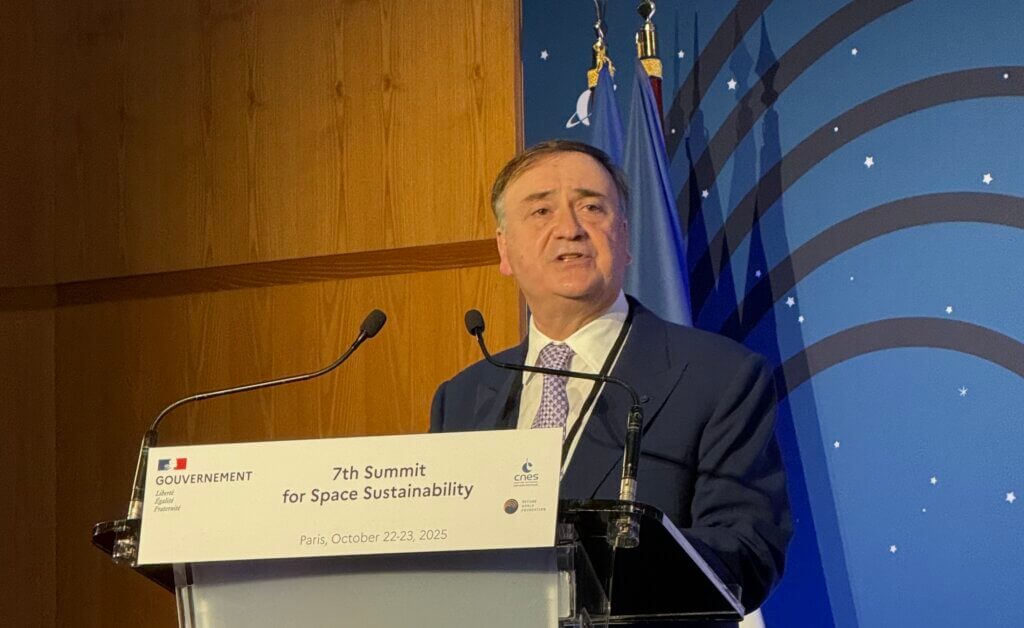
Space is crowded.
By ESA’s count, about 54,000 objects larger than 10 cm now populate Earth orbit, alongside 1.2 million pieces between 1–10 cm and 140 million between 1 mm–1 cm, with the total mass in orbit exceeding 15,100 tonnes. Each millimetre-class fleck can cripple a spacecraft; each breakup multiplies the risk.
We track a lot, but not everything.
Space surveillance networks catalogue about 43,500 objects, yet countless others remain too small to track but large enough to cause damage. The gap between “known” and “there” is where risk lives.
European leaders emphasized design-for-sustainability, life-cycle assessment (LCA), and eco-design, moving sustainability upstream into materials, manufacturing, testing, launch, on-orbit operations, and atmospheric re-entry. The narrative is no longer “don’t make a mess,” but “engineer for circularity.” Refuelling, repair, refurbishment, and active debris removal are becoming programmatic goals rather than panel talking points. ESA’s Zero Debris initiative and pathfinders like ClearSpace-1 have become shorthand for this shift from principles to procurement.
Meanwhile, CNES, France’s national space agency, highlighted three decades of steady policy attention and its early role in inter-agency debris coordination, a useful historical ballast as constellations scale. Consider just one slice of the picture: 8,475 Starlink satellites already in orbit, an upcoming total of around 3,200 Kuiper satellites, and China planning up to 27,000 satellites.
The math changes.
The collision-avoidance math changes when satellites are in thousands instead of hundreds, when debris pieces in hundred million, objects in LEO instead of GEO and so revisits and conjunctions must be measured in minutes instead of hours.
Why, What and How at the Summit
With the why elucidated above, the “what” and ¨how¨ are complex enough to fill two intense days of dialogue and debate.
- Traffic management vs. traffic coordination: Who owns the baseline safety service, and where do value-added tools fit?
- Standards, interoperability, and trust: Common data formats, contact points, and rules of manoeuvre to bring operators formally into a shared framework.
- From demonstration to deployment: Taking servicing, life-extension, and debris-removal missions from prototypes to commercial operations.
- Policy that scales globally without killing innovation: Regulation must expand without stifling new entrants or smaller players.
And because honesty is in our best interest: no single lever will fix this. The sector needs smarter satellites, smarter rules, and smarter markets, and better narratives that connect orbital hygiene to a farmer’s yield map, a ship’s route, or an ambulance’s arrival time.
The stakes.
More than 650 known fragmentation events – breakups, explosions, collisions – have already salted orbit with shrapnel. Each one is a reminder that the bill only gets bigger the longer we wait.
Addressing this urgency, the conference themes threading through the Summit’s flagship sessions include –
- “Real or Not Real” (on identifying technologies truly critical for long-term sustainability),
- “Fireside Chat with Industry CEOs” (on how satellite operators are embedding sustainability into business models),
- “Clearing the Air” (on the atmospheric impacts of launches and re-entries),
- “Leadership Roundtable: Progressing on Space Traffic Coordination” (on advancing global frameworks for data sharing and collision avoidance),
- ¨Spotlight Talk – Above and Beyond: SSA Trends to Watch¨ and
- “Staring into the Valley of Death” (on bridging the commercialisation gap).
As an avid space conference goer, I was encouraged to see a pronounced and critical shift from talk to action. Coordination, accountability, and circularity are no longer just terms but the principles of doing business in space. In this article we will address sessions 1 and 2.
(1) REAL OR NOT REAL: What Technologies Are Truly Critical to Ensure Long-Term Space Sustainability
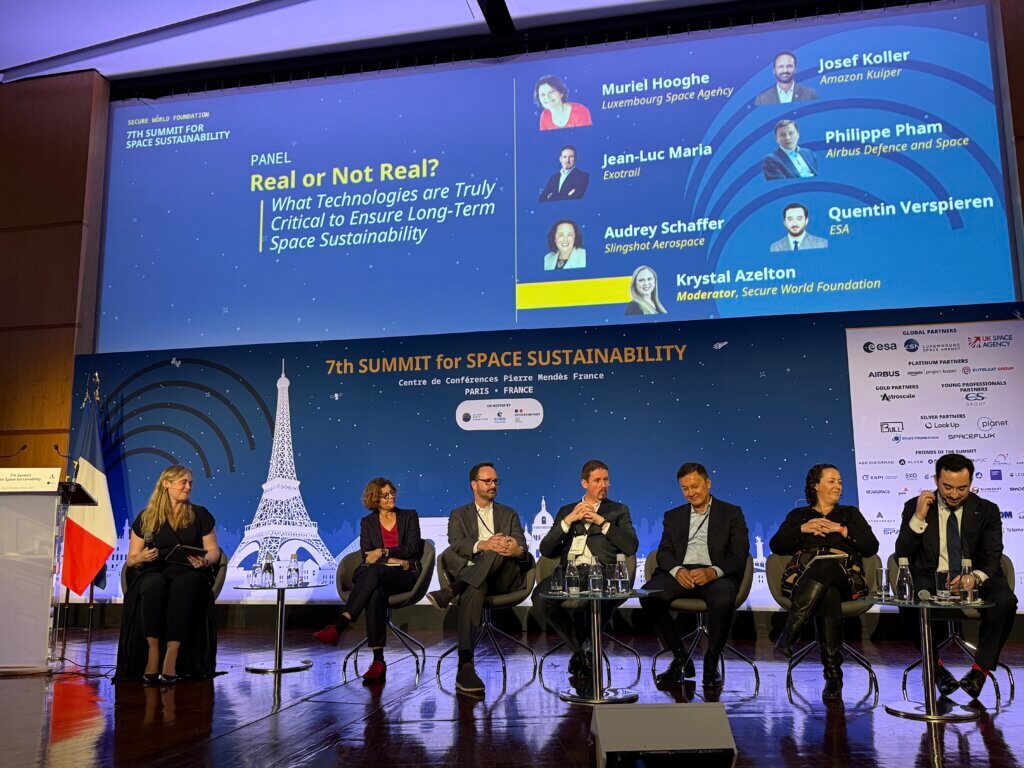
Moderator: Krystal Azelton, Secure World Foundation
Panelists: Muriel Hooghe (Luxembourg Space Agency), Quentin Verspieren (ESA),
Philippe Pham (Airbus Defence and Space), Josef Koller (Amazon Kuiper), Jean-Luc
Maria (Exotrail), Audrey Schaffer (Slingshot Aerospace)
The discussion moved quickly past why sustainability matters to the more demanding how: how to coordinate across public and private lines, fund real missions, and scale standards that actually stick.
Muriel Hooghe described Luxembourg’s effort to balance a thriving commercial sector with responsible practice. Initiatives such as the ClearSpace life-extension mission, NorthStar’s SSA tools, and Luxembourg’s role in the EU SST Partnership form part of that strategy. Signing the Zero Debris Charter alongside seven companies, she said, was both symbolic and practical – an explicit alignment between government and industry.
Quentin Verspieren underlined that ESA now embeds sustainability across all programs. Through its Zero Debris Approach, ESA commits every mission designed after 2030 to be debris-neutral, with tighter de-orbit deadlines, automated collisionavoidance, and standardized mechanical interfaces such as MICE and CAT for refuelling and capture. Public investment, he said, “de-risks innovation for regulators and industry alike.”
Philippe Pham connected sustainability with resilience. Airbus’s Vigil satellite with ESA will deliver 24/7 space-weather forecasting to protect orbital infrastructure. Sustainability, for Airbus, extends beyond debris: it includes longer spacecraft lifecycles, robust design, and resilient materials capable of withstanding harsh radiation and solar-flare environments. He argued for sturdier systems and a single regulatory baseline across Europe, warning that without it, “space risks becoming the Wild West.”
Josef Koller debunked the term “mega-constellation” as clickbait coined a decade ago – technically, he said, “mega” would mean a million satellites, and we are nowhere near that scale. Kuiper’s mission to connect 2.6 billion people is bound to a duty to operate responsibly. Its four-pillar framework covers inert krypton propulsion, ten-times-stricter manoeuvre standards, active de-orbiting to ensure full atmospheric demise, research into re-entry particle chemistry, and dark-and-quiet-skies mitigation using custom dielectric films on antennas that reduce optical reflection and radio interference.
Audrey Schaffer turned to the business reality of space-situational-awareness services. Slingshot’s global telescope network tracks objects from LEO to cislunar space, yet the market sits between a public safety obligation and private analytics. She stressed that governments must define which services remain public goods and which can be monetized. Without regulatory clarity and harmonization, she warned, investors will hesitate and innovation will stall.
Jean-Luc Maria closed the technical loop: “Without the ability to manoeuvre, avoid collisions, or de-orbit, nothing else is possible.” Exotrail’s work on compact electric propulsion and docking systems aims to make in-orbit servicing routine and to anchor a circular orbital economy.
Muriel Hooghe concluded with a dual plea for action and education: “Let’s fly these missions and train the next generation to keep them going.”
She later told me that her agency’s mission is to strike a balance between economic growth and environmental responsibility – nurturing new markets like in-orbit servicing (IOS) and space situational awareness (SSA) through smart policy on one side and demonstration missions on the other.
Key Insights / Takeaways
- Sustainability is mainstream: It now shapes mission design, policy, and industrial competitiveness.
- Technology and regulation must align: Active debris removal, refueling, and SSA analytics are achievable but need synchronized standards to scale.
- Public leadership drives markets: Government missions, funding, and procurement remain essential to commercial viability.
- Holistic approach: Sustainability now encompasses orbital safety, environmental impact, climate monitoring, and workforce development.
- Global coherence: Harmonized international rules and standards are the linchpin connecting technology, industry, and governance.
(2) Fireside Chat with Industry CEOs
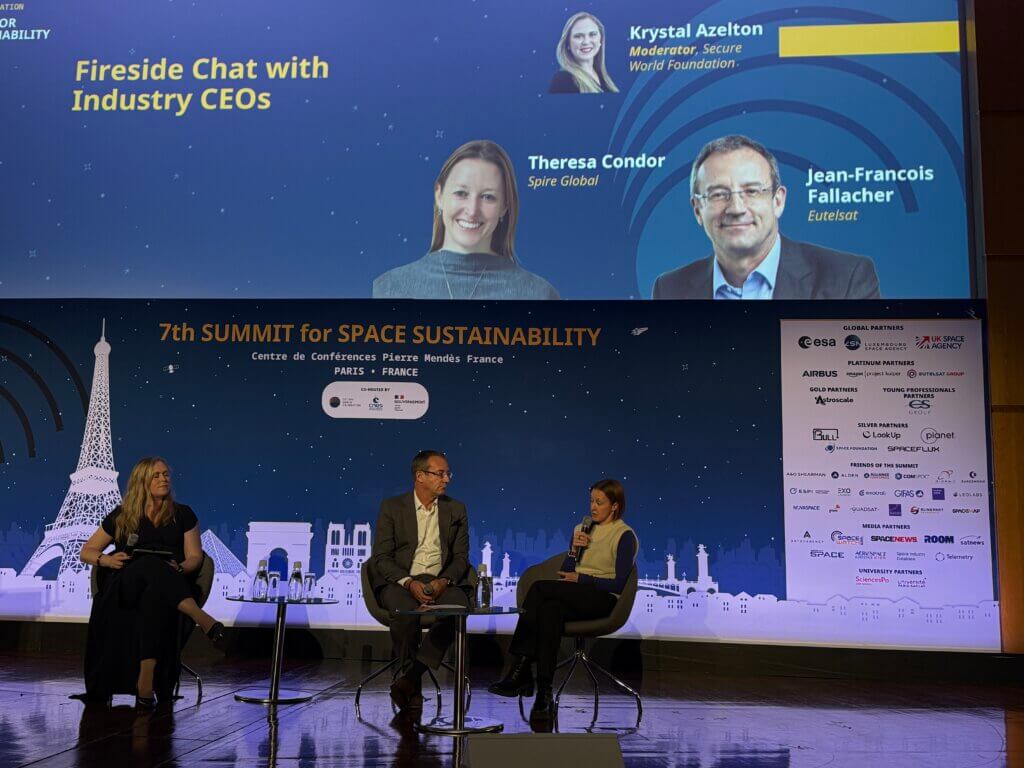
Moderator: Krystal Azelton, Secure World Foundation
Speakers: Theresa Condor, CEO, Spire Global | Jean-François Fallacher, CEO, Eutelsat
The CEOs of Spire Global and Eutelsat discussed how sustainability, regulation, interoperability, and dual-use strategies are reshaping commercial space operations.
Theresa Condor said Spire’s entire infrastructure operates in low-Earth orbit, giving it a direct stake in keeping that environment safe. Operating since 2013 with 50–100 satellites providing weather, wildfire, and safety-of-life data, Spire complies with the five-year de-orbit rule. Miniaturisation, she noted, is central: small, multi-use satellites that can update software and repurpose data deliver greater efficiency and reduce constellation size. Spire maintains 24/7 operations through its own ground network and works with multiple partners for debris tracking and situational awareness. Condor outlined four principles for workable regulation – clarity, efficiency, proportionality, and harmonisation – and stressed that commercial and defence sectors must pool resources to drive innovation and avoid duplicating infrastructure. She also pointed to emerging partnerships in SSA and SDA as essential to future sustainability.
Jean-François Fallacher described Eutelsat’s evolution from a 1977 GEO pioneer to operating a 650-satellite LEO broadband network at 1 200 km. Each satellite carries a de-orbit hook, and ESA projects aim to service them in orbit. He called for international coordination to overcome fragmented regulation and highlighted the industry’s lack of interoperability, noting that antennas between systems are incompatible – unlike in telecom, where global standards enable seamless connectivity. Dual-use, he said, lies at the core of Eutelsat’s strategy: a defence contract with France and 440 upcoming satellites hosting partner payloads unite sustainability with economic efficiency.
Together they underscored that collaboration, harmonised regulation, and sustainability-by-design are now central to responsible growth in LEO.
Conclusion: Sustainability Moves From Principle to Practice
The opening sessions of the Summit set a clear tone: space sustainability has moved from ambition to operational necessity. From Luxembourg’s policy leadership to ESA’s Zero Debris mandate, from Airbus’s call for durable systems to Kuiper’s emphasis on responsible constellation design, it is evident that long-term access to orbit now depends on decisions made today.
The Fireside Chat with Industry CEOs reinforced this shift on the commercial side. Theresa Condor showed how Spire embeds sustainability through miniaturisation, multi-use satellites, and continuous operational awareness. Jean-François Fallacher highlighted Eutelsat’s dual-use strategy, de-orbit hooks on every satellite, and the importance of international coordination and interoperability. Both CEOs pointed to a common reality: sustainability is inseparable from efficient regulation, shared data, and practical collaboration between operators and governments.
Taken together, these sessions revealed the next layer of complexity. Technology alone will not solve sustainability. It must rest on coordinated regulation, interoperable standards, public–private trust, and the ability to deliver value not only in orbit but on Earth – for climate monitoring, communications, transport, and emergency services.
In Article 2 of this series, we leave orbit and turn to the scientific frontier: the atmospheric effects of launches and re-entries. Early data, open questions, and evolving research underscore the need to understand humanity’s growing footprint in the skies above.

Novi Dewan is an engineer, author, and speaker with an MBA. She has a decade of experience in logistics, technology consulting, project management in companies like Amazon, Capgemini and DHL. Based in Dusseldorf, she is currently pursuing her PhD with her first two papers focused on humanitarian logistics and her final one exploring space traffic coordination and space sustainability. Novi loves drawing unexpected parallels across the entire spectrum of logistics – on Earth and far above it. In her free time, you might catch her paragliding in very near-Earth orbit or hanging out with her furry Maltese co-pilot, Einstein.