by Torsten Kriening, Publisher SpaceWatch.Global
Europe’s usual reflex for a strategic problem is to design the institution first and deliver the capability later. The clearest message from the first Vaduz Space Dialogue was that on secure connectivity, Europe no longer has time for that order of events.
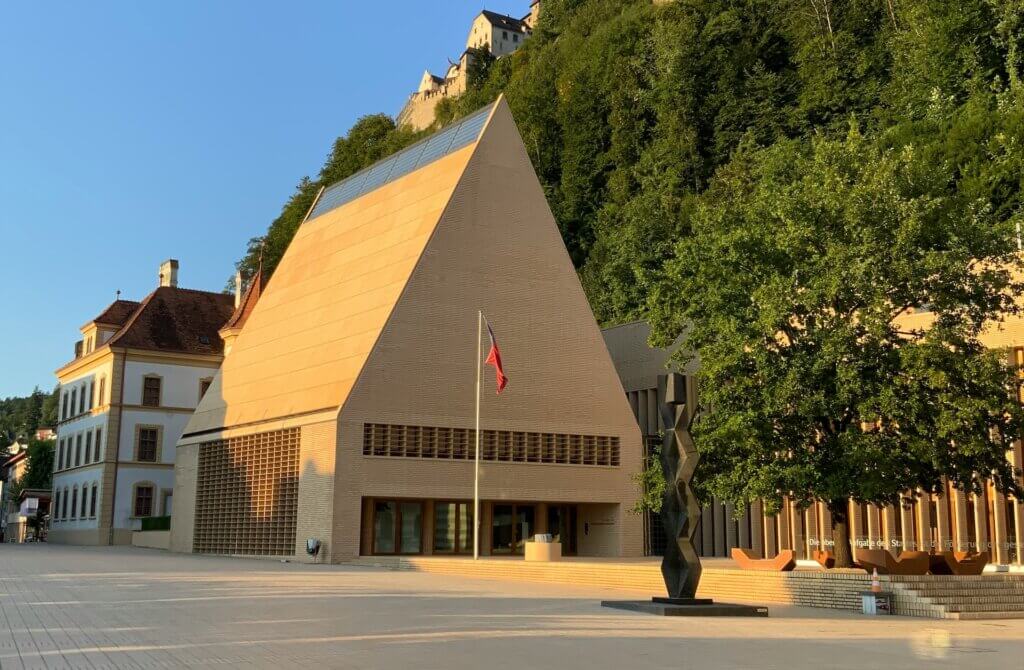
On 28 September, Liechtenstein’s Ministry for Home Affairs, Economy and Sport brought together representatives of European governments, institutions and industry, in cooperation with Open Cosmos and with the support of the European Space Policy Institute (ESPI). The topic was federation: connecting national, institutional and commercial satellite systems so that together they deliver resilient connectivity for Europe, while each owner keeps control of its own assets.

In the closed-door session, held under the Chatham House Rule, the discussion kept returning to one point. If Europe waits for a perfect institutional framework, others will move ahead. The tools needed to cooperate now are already known.
The clock is running
Hermann Ludwig Moeller, Director of ESPI, explained the urgency in an interview with SpaceWatch.Global. When Europe launched GOVSATCOM and IRIS², the world was a different place. Since then, requirements have moved sharply from governmental towards military use, and Starlink has come to dominate the market. Moeller pointed to a hard deadline in 2029, by which governmental services and military support have to be delivered with what is available today.
He was equally clear that copying Starlink is not the answer. A single system is a single point of failure, especially if it depends on one entrepreneur and on governance that may have a foreign government behind it. Europe, he argued, is used to working in federation, and should apply that principle to connectivity.
A toolbox, not a wish list
The official summary of the Dialogue lists the practical requirements: common technical interfaces and service standards, security accreditation, capacity-sharing arrangements, national frameworks for authorisation, registration and liability, and coordination of frequency assignments.
Read one way, that is a list of everything Europe still lacks. Participants of the Vaduz Space Dialogue read it the other way. None of these steps needs a new treaty, agency or programme. Each can be negotiated between willing governments and operators now, and each makes cooperation possible before a full European architecture exists.
Moeller described the same logic in two tracks. The first is immediate interoperation through technical interfaces and governance schemes. The second, running in parallel, is a deeper level of integration, which could come through joint ventures, a new actor, or telecom operators bringing commercial scale.
Starting small, starting now
The partnership between Liechtenstein and Open Cosmos is an early test of that approach. The Principality administers satellite network filings under the ITU Radio Regulations. According to Open Cosmos founder and CEO Rafel Jordá Siquier, those filings were made early and therefore have high priority in Ka-band. They are global and cover a polar constellation, which also fits Open Cosmos’s own polar Earth observation constellation.
Two satellites built by Open Cosmos launched in January 2026, and more are ready. Liechtenstein and Open Cosmos say they will develop the capability on an open and interoperable basis, so that it can complement national systems in Germany, Spain and Poland as well as IRIS², GOVSATCOM and ESA resilience programmes.
Starting now does not mean skipping governance. Dr Bianca Lins, Liechtenstein’s Head of Space, told SpaceWatch.Global that access, priority and escalation rules must be agreed before they are needed, not in the middle of a crisis. “Federation should therefore not mean transferring control from Vaduz to Brussels,” she said. The rules can be written now, between the partners who are ready.
Fragmentation as an asset
Europe’s critics often describe its space sector as fragmented. In Vaduz, participants turned that around. Capabilities, expertise, spectrum, launch sites, finance and industry are spread across many countries. Connected intelligently, that diversity becomes resilience: several systems, several supply chains and several governance structures, with no single point of failure.
The same reasoning applies to infrastructure. The room’s view was that Europe does not need more infrastructure everywhere. It needs to make better use of what it already has, and federate national and commercial assets to reach scale.
The market is the missing link
Being bolder and faster is not only a matter of regulation. Participants agreed that demand for space-enabled services in Europe is clear. The question is how to turn that demand into viable markets, investment and European capability.
Europe has the technology and increasingly the appetite to invest, as Open Cosmos’s recent €300 million round shows. What is still missing is enough public procurement and growth financing for European companies to scale in Europe rather than abroad. Launch remains a strategic bottleneck, participants noted, but it is only one part of the picture. Resilient supply chains, interoperable systems, access to spectrum and a market that actually buys European services matter just as much.
There was also a call for more confidence. Europe does not need to import every investment model, technology or idea. Much of the expertise, capital and entrepreneurial capacity it needs is already here.
A role for a small state
This is where Liechtenstein’s contribution goes beyond its filings. The Principality is in the European Economic Area but not the EU, and has close ties to Switzerland. It sits between frameworks that do not always meet naturally. Its small size lets it move quickly, and its reputation rests on reliability.
Lins described the national space strategy now in development in the same terms: Liechtenstein wants to be “highly specialised, reliable and well-connected” rather than a builder of large national infrastructure. Spectrum is the entry point. Industry, space data, regulation and finance are the longer game.
Participants asked Liechtenstein, together with Open Cosmos and supported by ESPI, to continue the dialogue through 2027. That gives Europe a standing forum where the toolbox can be put to work, not just discussed.
My take
What set Vaduz apart was a combination of foresight and boldness. Europe has spent years describing what a sovereign secure connectivity architecture should look like. With 2029 approaching and one foreign provider dominating the market, the more urgent question is which parts can start this year.
Standards, interfaces, accreditation and capacity-sharing are not glamorous. But they are the difference between a federation on paper and one that carries traffic. Europe does not need everyone at the table to begin. It needs the partners who are ready to go first, and a small country willing to host the conversation.