Europe’s next move on secure connectivity was not pitched in Brussels or Paris, but in Vaduz – capital of a country of roughly 41,000 people with no army, yet holding strategically relevant satellite network filings. In space, as Torsten Kriening puts it, spectrum is strategic infrastructure.
The Vaduz Space Dialogue examines an idea gaining traction: federation. Rather than building one more system, the proposal is to connect those that already exist – national, commercial or European – with every owner retaining control of its own assets. The timing matters. GovSatCom already pools governmental satellite capacity and IRIS² will add another layer, but full service remains years away, while Germany, Spain and Poland develop national systems and the war in Ukraine has demonstrated the risk of depending on someone else’s constellation.

Dr. Bianca Lins, who is leading the development of Liechtenstein’s first national space strategy, addresses the question at the heart of it: if Liechtenstein’s spectrum carries European government traffic, who decides access in a crisis? Her answer is unambiguous – such matters cannot be settled mid-crisis. Access, priority and escalation rules must be agreed in advance, with clarity on authorised users, prioritisation, accountability and crisis access. Federation, she stresses, should not mean transferring control from Vaduz to Brussels, but agreeing beforehand how nationally controlled assets can serve a common European purpose while preserving sovereign decision-making. Looking to 2035, she describes an ambition far broader than filings: connecting Liechtenstein companies to European and international value chains, developing space data and applications, building on regulatory expertise, and being highly specialised, reliable and well connected rather than building large national infrastructure.
Rafel Jordá Siquier, founder and CEO of Open Cosmos – Liechtenstein’s strategic industrial partner for the connectivity initiative – explains what makes the filings distinctive. Filed very early, they carry high priority in Ka-band, helping minimise future interference and offering a solid foundation for building European capability. The Ka-band allows substantial data transmission from relatively small terminals, and the polar constellation holds strong synergies with Open Cosmos’s polar Earth observation constellation, enabling real-time delivery of information from sensing satellites to end users.
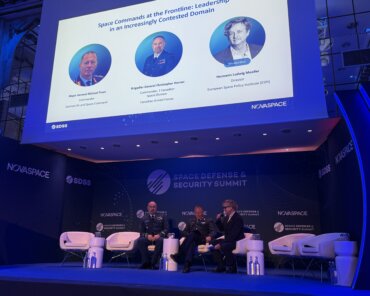
Hermann Ludwig Moeller, Director of ESPI, sets out the strategic context. The world has shifted since IRIS² and GovSatCom were initiated: governmental requirements have given way to far more military ones, Starlink now dominates supply, and Europe’s financial markets have matured. Should Europe copy Starlink? His answer is a clear no – a single system, dependent on a single entrepreneur and a single governance structure, is a single point of failure. Europe is accustomed to working in federation, balancing European and national priorities, and that is precisely where its resilience lies. He argues for a dual objective: pragmatically ensuring governmental and military services are available by the hard 2029 deadline, while simultaneously stimulating commercial markets to make the enterprise sustainable.
Kriening’s own assessment is measured. Vaduz did not solve European secure connectivity and never claimed to. What it did was place spectrum and satellite filings on the strategic agenda, alongside launchers and satellites. Liechtenstein is not selling frequencies; it is using them as the starting point for a broader strategy spanning industry, data, regulation and partnerships. Whether federation succeeds, he suggests, depends on three things he will be watching through 2027: a clear governance model, interoperability and secure technical arrangements, and additional public or commercial partners willing to contribute or use capacity. If those come together, federation becomes an architecture – and Vaduz will be where it started.