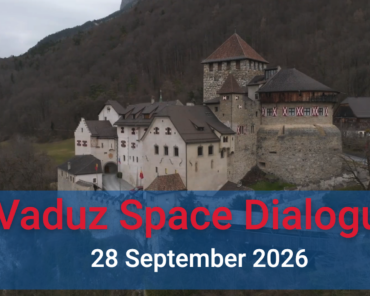
From the 20th ESPI Annual Conference, held this year at the Palais Liechtenstein in Vienna, Torsten Kriening speaks with Dr. Bianca Lins of Liechtenstein’s Office for Communications – the authority responsible for electronic communications, the postal sector and media, and, since 1 January 2024, for space, the department Lins leads.

The conversation builds on the Vaduz Space Dialogue documented by SpaceWatch.Global a few weeks earlier, and addresses the question many readers raised: why Liechtenstein? Lins explains that the country has one operator, Open Cosmos, using Liechtenstein frequency spectrum to build a constellation in low Earth orbit – which is how the sector came to fall within the office’s responsibilities in the first place. Ongoing discussions with the company, set against daily geopolitical developments, led to the conviction that framed the first Vaduz Space Dialogue: even a small country can argue that Europe must stand together.
Her case for federation is both pragmatic and persuasive. Europe already possesses considerable capabilities, but as was also noted during the conference, they remain fragmented. The answer, Lins argues, is to take those individual pieces and pull them together – agreeing the necessary rules and standards so they can genuinely work in concert. Europe does not need to copy China or the United States, nor does any single country need to build and launch thousands of satellites. Instead, it can use what already exists and what is already planned, federating those assets into one European system.
Looking ahead, Lins is currently finalising the draft of Liechtenstein’s first national space strategy, whose direction was presented at the first space dialogue. The next step is government approval of that direction, followed by parliament next year. She is careful to note that Liechtenstein is not new to the sector – the country has been involved for decades, with domestic industry already supplying the space sector. What has changed is the pace of commercialisation, and the strategy aims to build a space cluster to support and coordinate that industry while connecting it with international partners, relationships the country has developed considerably in recent years.
One specific area under discussion is the use of data, which requires relatively little physical space. Here Lins points to Liechtenstein’s defining asset: trust. Nobody, she observes, is afraid of Liechtenstein; everyone understands the country is not using data to conquer the world, but is a genuinely trusted partner.
On Open Cosmos, Lins confirms the seven-year milestone period is already running, tied to the original filing, and that a force majeure claim has been submitted to the ITU, expected to be considered by the Radio Regulations Board.