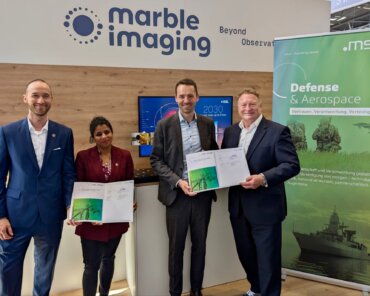
From the Grand Palais on day two of the International Space Summit in Paris, Torsten Kriening sits down with Robert Hook, CEO of Marble Imaging, with the company’s first satellite on display behind them.
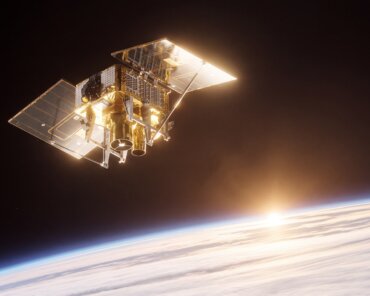
Built by Reflex Aerospace and launching early next year, the satellite is designed to deliver sovereign European very high resolution data. Hook describes its two optical instruments: a submeter instrument for visible and near-infrared imaging, and a lower-resolution shortwave infrared instrument whose breadth of spectral bands opens up new use cases – notably for security and defence users seeking new types of information under German and European control.

The conversation turns to two announcements made at the summit. Thrust Me is supplying the satellite’s propulsion system, new technology that will help maintain a five-year orbital lifetime and ensure continued delivery of high quality data, with performance so far exceeding expectations. Looking further ahead, Marble Imaging has begun developing a 50 cm payload together with Safran, with Safran providing the hardware and Marble the data processing, targeting the delivery of sub-50 cm data from the end of 2028 and further strengthening European sovereignty in this critical domain.
Continuity of data emerges as a central theme. Building an extensive archive allows customers to track how things evolve over time, while higher resolution will sharpen capabilities such as object detection – already a key feature of the company’s offering. The first satellites will fly in sun-synchronous orbits, driven largely by launch availability, while future generations will move to mid-inclined orbits with the aim of achieving 30-minute revisit rates.
Asked about the persistent question of Franco-German collaboration in space, Hook offers a refreshingly pragmatic answer: the partner had a very good product, and has proven it by delivering a payload with excellent performance. Europe, he argues, needs sovereign data quickly – within one or two years rather than the typica