Wildfire is testing whether Europe’s space sector can stop selling pixels and start acting like a utility. A Munich Climate Week panel showed what that means in practice.
By Torsten Kriening, Publisher, SpaceWatch.Global

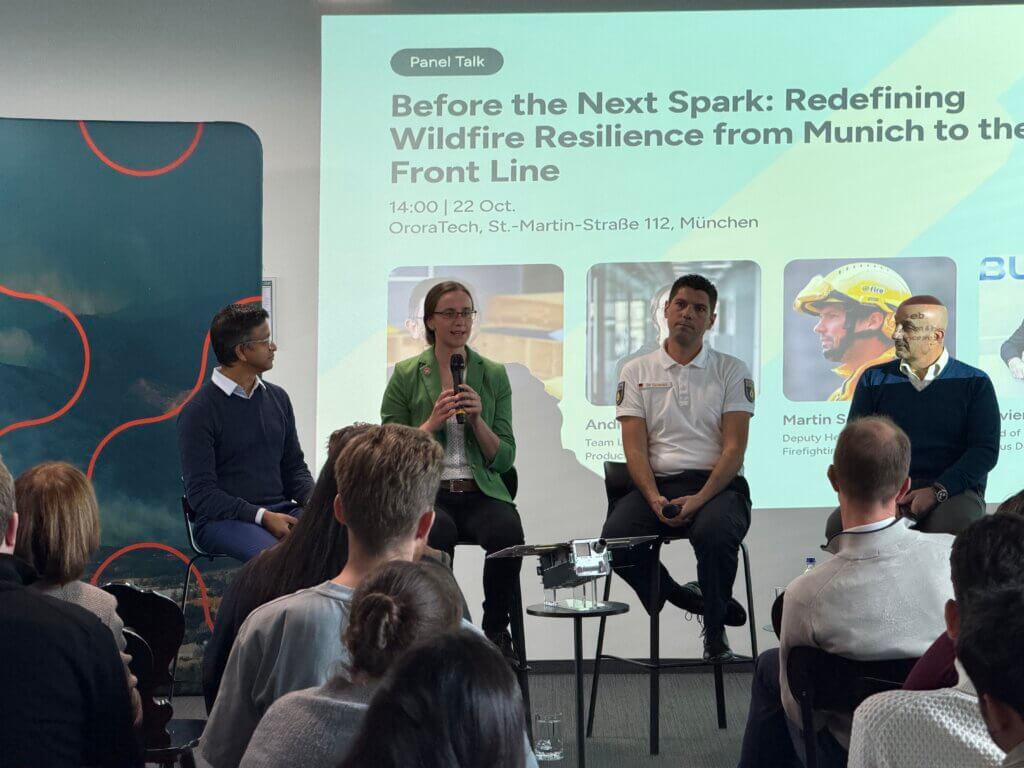
At climate weeks, space usually appears as a slide: a beautiful image of Earth, a statistic about how much climate data comes from orbit, and polite applause. Last Thursday at OroraTech’s headquarters in Munich, it was different. At “Before the Next Spark”, co-hosted with Airbus Defence and Space as part of Munich Climate Week, the most interesting remarks about satellites came from a firefighter. Most of them were about what satellites cannot do on their own.
Our industry should listen to that outside view more often. Space is not the hero of the wildfire story. At best, it is part of the infrastructure that helps the people on the fire line make better decisions. I don’t see that as a demotion. I see it as the business model for the next decade.
The fire is personal
Before any technology was discussed, the panel talked about people. Olivier Chalvet, Head of Wildfire Mission at Airbus Defence and Space, grew up near Nîmes watching Canadair water bombers fly over his house. This summer he helped evacuate his own town near Bordeaux, and then he was evacuated himself. Martin Schmid of @fire and Andrea Spichtinger of OroraTech both joined youth fire brigades as children. When the moderator asked the audience who had been affected by a wildfire, hands went up.
That matters. Wildfire is often reported as hectares and emissions. For those affected, it is a lost home, a cancelled town festival, or a night spent waiting for the wind to drop. Any technology we build has to serve those people, and the firefighters who stand between them and the flames.
The problem is moving north
The numbers explain why a Munich audience was talking about fire in October. 2025 was the EU’s worst season on record: more than 1.07 million hectares burned, with fires mapped in 25 of 27 member states. Only Luxembourg and Malta escaped. Germany recorded its highest burnt area since European satellite records began in 2006.
2026 brought no relief. In Gironde, a single fire burned around 42,000 hectares, France’s largest since 1949, and destroyed 240 homes. Nationally, France lost close to 100,000 hectares and evacuated some 220,000 people. In Germany, the Hürtgenwald fire in August became the largest North Rhine-Westphalia has ever recorded. By the end of July, the country had already burned roughly twice its long-term average.
Schmid described the trend in terms that belong in every policy paper. The risk does not advance like a line on a map. It moves like a wildfire throwing spot fires. Some years Germany will be hit, some years it will not. If you plan for the average, you plan for the wrong thing.
“I don’t care about data”
Schmid, deputy head of @fire’s wildland firefighting branch, put it bluntly: “I don’t care about data. I want to have knowledge at the end.” That is a sentence every space company should hear.
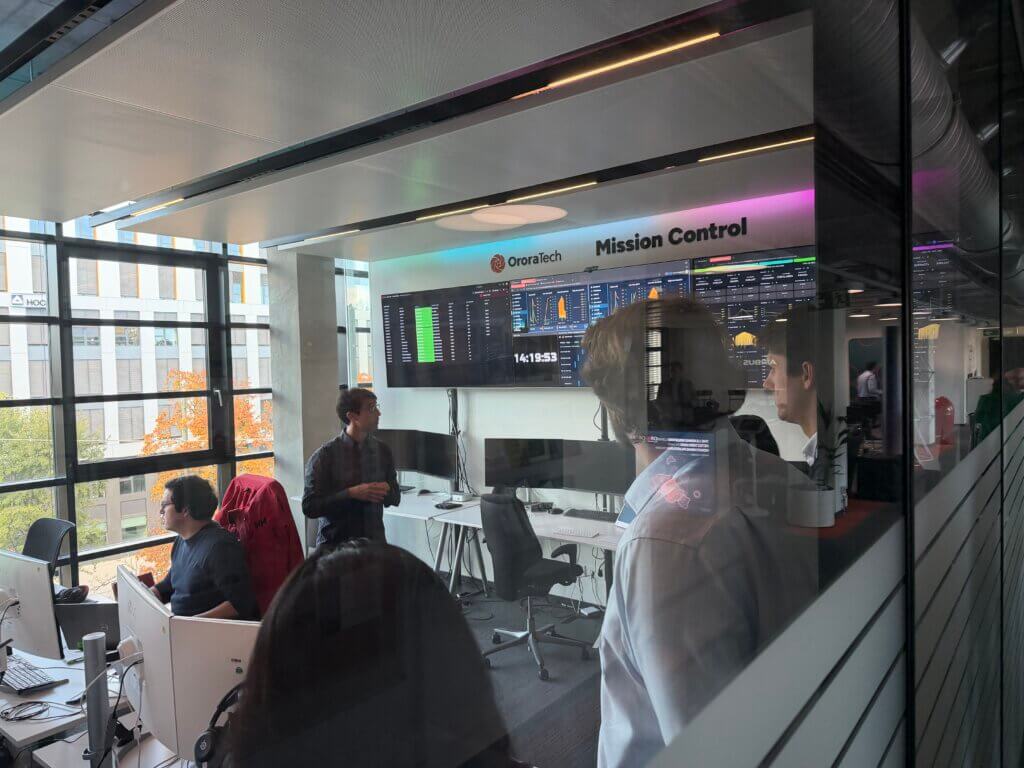
OroraTech has done what I would expect from a space company. It found a structural gap, an afternoon window when no high-resolution thermal satellite passed overhead, exactly when fires are often at their most active. Then it placed its constellation in that window. With the launch of FOREST-20 this month, it has 20 satellites in orbit, and Spichtinger described a path towards 15-minute revisit. She also gave the examples that count for more than any spec sheet. Responders in Quebec used the company’s maps in morning briefings after they had lost the overall picture. In Chile, forestry operators launch helicopters on its detection alerts.
But the firefighter’s point stands. Detection is the beginning of the value chain, not the end. Schmid noted that Germany lacks national fuel maps and fuel-load and moisture data. Without those, even perfect hotspot detection cannot tell an incident commander which kind of fire is burning. Most fires are contained early by a handful of crew. A few become mega-fires within the hour. Chalvet called that initial-response decision the fundamental question. That is where space has to deliver.
The 1940s radio problem
Chalvet also pointed to a gap that surprised much of the audience. Aerial firefighting still runs on analogue voice radio that a Second World War pilot would recognise. For a long time, that was good enough. With dozens of aircraft over a single fire, it no longer is.
This is where “space as infrastructure” stops being a slogan. In a wildfire, Earth observation, positioning and satellite connectivity are not three separate markets. They are one system, and its job is to put the right information in front of the right person: the commander, the pilot, the crew at the fire front. “We do it every day in defence,” Chalvet said. The architecture exists. What is missing is the will to apply it to civil protection, and the procurement routes to pay for it.
Civil protection is becoming civil defence
That brings me to security. Chalvet reported that in NATO climate-security discussions, wildfire is increasingly treated as a hybrid-threat multiplier, because a major fire ties down national forces and displaces thousands of people. Chatham House argued in August that NATO recognises climate change as a security threat but has not explicitly designated climate adaptation as defence-related spending.
That gap is an opportunity for Europe’s space sector, and a responsibility. Dual use is not a marketing term when the same thermal constellation that spots a fire in the Landes can also monitor critical infrastructure or a military training area. Greece has already shown the sovereign model. OroraTech built the four-satellite Hellenic Fire System, the country’s first dedicated wildfire constellation. I expect more governments to want their own slice of this infrastructure rather than a subscription.
Speed is space’s advantage. Governance is its bottleneck.
Compare the timelines. France signed for new DHC-515 water scoopers in June, yet reports suggest EU-ordered aircraft may not arrive before 2032. Meanwhile, a Munich small-satellite operator put 18 satellites into orbit in 18 months. Space can put capability in place quickly.
What space cannot do is create the institution that uses that capability. France’s parliamentary mission reported on 28 September. It called for single, integrated national steering of risk, prevention and civil security, and made property “defensibility” a guiding principle of urban planning. Germany, with 16 Länder and no national body that owns the problem, is further behind. Schmid noted that much of @fire’s national guideline work is done by volunteers, in their own time and out of passion. Technology plugged into fragmentation stays fragmented.
Technology without training is also a liability. Schmid described meeting a crew member whose new truck had a self-protection system. All he knew about it was which button to press. In a smoke-filled cab, with a fire front passing overhead, that is not enough, and the cost of getting it wrong is a human life. The same applies to dashboards and alerts: if incident commanders do not trust a tool, or have never trained with it, it might as well not exist. Schmid also warned about a sentence every German firefighter knows: “Das haben wir nie gebraucht”, we’ve never needed it. That sentence cuts both ways. It describes the user who refuses new tools, and the supplier who assumes users will adapt to them.
What the space sector should take away
- Sell outcomes, not pixels. The customer is buying minutes saved in initial response, not ground sampling distance.
- Integrate or be ignored. Earth observation that does not reach the cockpit and the command post through interoperable networks remains a research product.
- Embrace dual use. Help governments build the procurement and budget lines for it, including within defence and resilience spending.
- Invest in the human layer. Training, feedback loops and local adaptation are part of the product. Spichtinger was right that every region has different needs, and serving them is a cost of doing business, not a distraction.
Before the next spark
Wildfire is a vivid test case, but it is not the only one. Floods, droughts, heat stress on power grids and attacks on critical infrastructure follow the same pattern. What these crises demand is not more satellites for their own sake. They demand a reliable layer of observation, connectivity and positioning that other professions can build on without having to think about it.
That is what infrastructure is: something you only notice when it fails. Europe’s space sector should aim to become that unnoticed, indispensable layer. By bringing climate experts, industry and first responders into one room, Munich Climate Week was the right place to make that case. The next fire season will tell us whether we listened.
This opinion piece is based on the audio recording of the event “Before the Next Spark: Redefining Wildfire Resilience from Munich to the Front Line”, held at OroraTech in Munich on 22 October 2026 as part of Munich Climate Week.
Disclosure: OroraTech is a SpaceWatch.Global business partner.