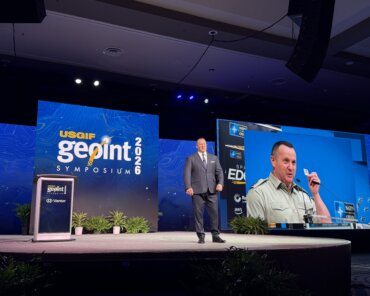
At GEOINT 2026 in Aurora, Colorado, Torsten Kriening spoke with Ronda Schrenk, CEO of the United States Geospatial Intelligence Foundation, about the growing scale of the GEOINT community and the questions now shaping it.

This year’s event brought together thousands of participants from government, industry, academia, and partner nations. But the atmosphere felt different from many recent conferences.
Less presentation.
More operational focus.
Forward Day in particular stood out for its substance. Panels moved quickly into concrete discussions around mission relevance, AI integration, and emerging operational realities. Schrenk attributes much of that to a broader planning structure involving external experts, laboratories, and peer-reviewed speaker selection rather than relying solely on standard conference programming.
One change this year reflected that approach directly.
For the first time, GEOINT opened speaker submissions through a broader call process, with external reviewers evaluating proposals against mission relevance and practical value. The result was noticeable on stage. Fewer generic panels. More discussions grounded in actual use cases.
Artificial intelligence dominated many of those conversations, but not in the way it did a year ago.
The question is no longer whether AI belongs in GEOINT workflows. That debate has largely passed. Attention has shifted toward implementation speed, operational trust, and institutional readiness.
For Schrenk, the biggest obstacle is no longer technical.
It is organizational.
Policy frameworks, procurement structures, and institutional culture move slower than the technologies now entering operational use. That becomes especially visible
in multinational environments where coordination depends on alignment across governments, agencies, and alliances.
Underlying all of it is a simpler point.
Geospatial intelligence sits beneath almost every operational decision. Not because maps matter on their own, but because understanding where something happens remains central to understanding what it means.
That is why the GEOINT community keeps growing.
And why the pressure on it is increasing just as quickly.