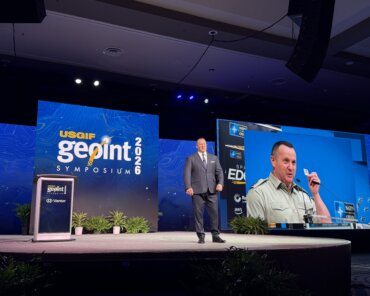
At GEOINT 2026 in Aurora, Colorado, Torsten Kriening spoke with Eric von Eckartsberg at the EarthDaily Analytics Federal booth, shortly after the company expanded its growing satellite constellation.
Six new satellites are now in orbit, joining the spacecraft launched previously and moving the company closer to a full ten-satellite operational system. Data delivery is expected to ramp up over the coming months.

The technical specifications are substantial. Multiple spectral bands, thermal and methane sensing, wide-area coverage, and daily revisit capability. But for EarthDaily, the main selling point is not higher resolution.
It is consistency.
The company’s approach depends on repeatedly imaging the same locations under nearly identical conditions. Same angle, same sensor geometry, same acquisition pattern. The reasoning is straightforward. AI systems tasked with detecting change perform poorly when the input itself changes from image to image.
In other words, many false positives are not caused by activity on the ground.
They are caused by inconsistent collection.
EarthDaily’s system is designed to reduce that problem by treating repeatability as infrastructure rather than convenience. The goal is not simply to collect imagery, but to build a stable time-series dataset that AI systems can reliably compare across days, months, and eventually years.
That changes how events are detected.
Instead of tasking satellites toward known incidents, the constellation continuously captures broad areas, allowing unexpected developments to appear naturally in the data. The comparison becomes temporal rather than reactive.
The company’s newly announced NRO contract adds another layer of significance. Government interest increasingly centers not only on access to imagery, but on access to consistent datasets suitable for large-scale AI analysis.
Resolution still matters.
But at GEOINT 2026, the more interesting conversation was about trust in the data itself.