Berlin, 16 September 2026 – German Defence Minister Boris Pistorius visited the Berlin defence-tech company MKS – Missionskritische Systeme on Monday, accompanied by Steffen Krach, SPD chairman for Berlin. The visit to the Resilience Technology Campus was a deliberate signal about what the ministry now prioritises: getting new technology into the hands of the armed forces faster.
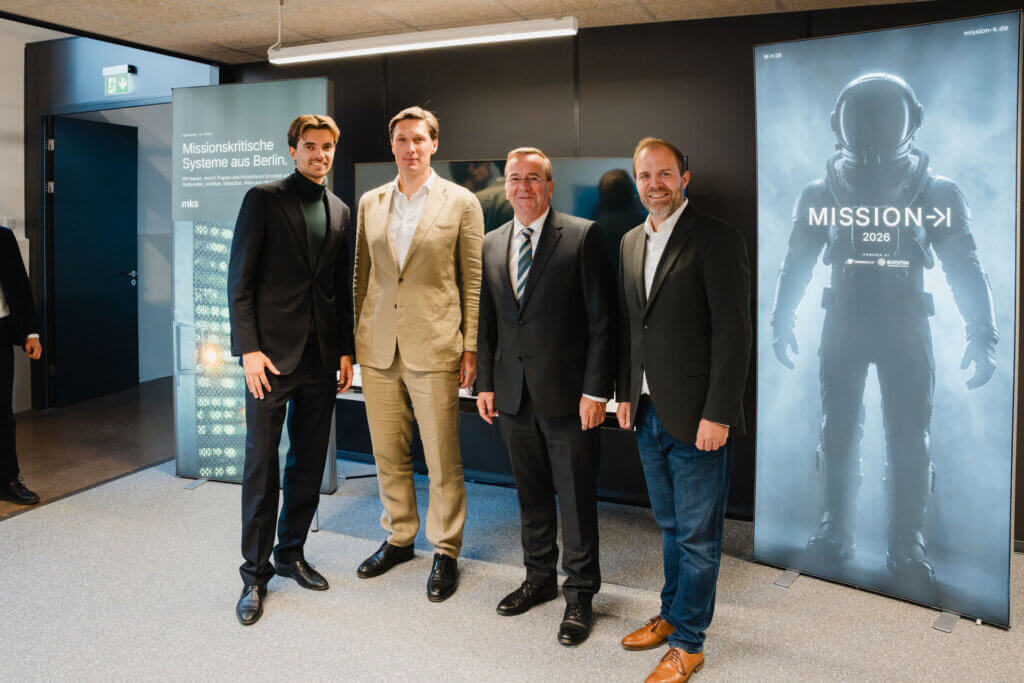
Founded in 2026, MKS builds sovereign software that consolidates the Bundeswehr’s logistics and deployment movements and integrates sensors, effectors and industrial systems into military command and situational awareness architectures. The design requirement is unusual and revealing: the systems must continue to function when networks are deliberately disconnected or placed under heightened protection. Its customers include the Bundeswehr, NATO and German security authorities.

What makes the visit worth reporting beyond the photo opportunity is something Pistorius said in conversation rather than from a podium.
He remarked that he is still asked, with some regularity, why the Bundeswehr needs to be in space at all. His standard answer: Germany is not sending soldiers into orbit “Space Has Become Part of the Battlefield” – Pistorius Visits Berlin Defence-Tech Start-up Ahead of Mission-K but space is a domain in which the armed forces will have to operate considerably more in future. Through satellites, he said, it has become part of the battlefield, and it contains infrastructure that must be protected.
That framing deserves attention. Nearly a year after Germany adopted its first Space Security Strategy in November 2025, and with €35 billion committed to military space through 2030, a sitting defence minister is still fielding the basic question of why space matters. The strategic case has been made at cabinet level. It has evidently not travelled as far into the public conversation as the budget figures might suggest.
The visit also covered critical infrastructure, which connected naturally to the company’s work and to the next item on the agenda.
Mission-K takes shape at Kalkar
MKS is convening Mission-K on 29 and 30 September at Wunderland Kalkar – a new German space and defence platform bringing together armed forces, industry, start-ups and research. It is carried by 35 network partners and more than 100 participating companies, with backing from the Bundeswehr Space Command, the space operations directorate at the Federal Ministry of Defence, and the Air Force Command. This year’s partners include ArianeGroup, Evonik and Airbus Defence and Space.
The format is built around three challenges developed jointly with the Space Command: protection of German space infrastructure, resilient materials and supply chains, and secure satellite communications for mobile ground stations.
Major General Michael Traut, Commander of the Bundeswehr Space Command, is among the confirmed participants.
“With MKS we are building sovereign military software ourselves. With Mission-K we are bringing together the ecosystem that can move new technologies into application faster,” said Alexander Kleinschmidt, founder and managing director of MKS and initiator of Mission-K. “Germany has strong industry, excellent research and a growing defence-tech scene. What matters is turning that into deployable capability more quickly.”
Pistorius was invited to this year’s edition, but the timing proved too short notice. He is reviewing attendance at Mission-K 2027, scheduled for 5 and 6 October.
That the location is Kalkar is quietly fitting. The Bundeswehr Space Command sits at Uedem, twenty kilometres away – and the site of a nuclear plant that never went into operation is now hosting a conference about protecting infrastructure that very much does.