Ibadan, 12 March 2026. – Surrey Satellite Technology Ltd (SSTL) has announced its role as a key industrial collaborator in the Eric and Wendy Schmidt Observatory System’s Lazuli, an initiative that aims to deliver one of the most ambitious privately-funded space telescopes ever conceived.
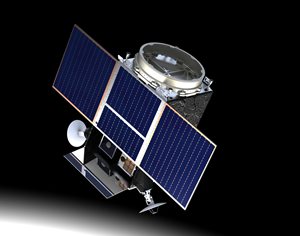
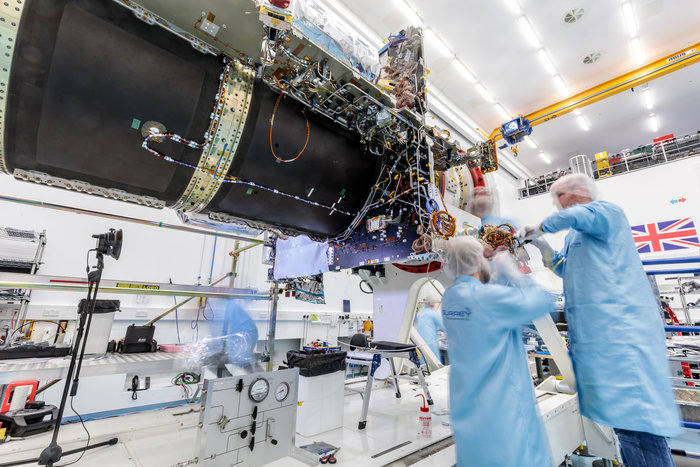
As part of the program, SSTL will develop the spacecraft platform for the mission, which will carry the Lazuli Space Observatory far beyond Earth orbit into deep space. The Lazuli Space Observatory aims to become the first full-scale privately funded space telescope, with a primary mirror larger than that of NASA’s iconic Hubble Space Telescope.

The observatory will carry a suite of advanced instruments, including a wide-field camera, an integral-field spectrograph and a coronagraph, enabling rapid and responsive studies of exoplanets, supernovae and transient cosmic events.
The satellite manufacturer brings to the project, a long track record of delivering highly capable space missions using a fundamentally different approach to spacecraft design and delivery. The company will thereby apply its philosophy of delivering performance traditionally associated with larger, expensive systems at a fraction of the cost and timescale to the future space observatory, by leveraging a faster and more flexible development model.
SSTL’s deep-space platform will consequently provide the precision pointing, propulsion capability and communications necessary to deliver and operate the observatory in a stable deep-space orbit well away from Earth, supporting the mission’s demanding scientific objectives.
“SSTL has a way of doing space differently,” explained Andrew Cawthorne, Managing Director, SSTL. “Our heritage shows that you don’t need to rely on vast, exquisite systems to deliver extraordinary capability. Lazuli takes that same thinking into deep space.”
“While SSTL is known for small satellites, ‘small’ has always described our approach, not the size of the satellite – and certainly not our ambition. Lazuli is a powerful example of how that philosophy can scale to enable a new generation of deep-space science missions.”
Lazuli forms part of the wider Schmidt Observatory System, which combines rapid development, open data access and global collaboration to dramatically lower barriers to participation in frontier astronomy.