Ships switching off their trackers. Undeclared rendezvous near the Arabian Peninsula. Icebreakers clearing routes for unidentified vessels in the Arctic. These are no longer edge cases. They are part of an operational reality that thermal intelligence from space is beginning to make visible.
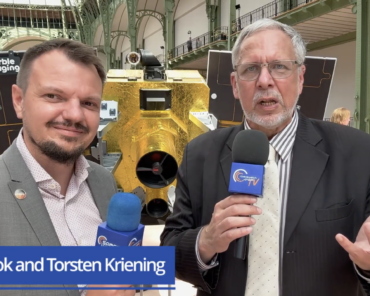
At DGI 2026 in London, SpaceWatch.Global publisher Torsten Kriening speaks with Max Gulde, co-founder and CEO of Constellr in Munich. Their conversation explores what thermal data can reveal that traditional Earth observation cannot, and why Europe must urgently build a competitive thermal intelligence ecosystem.

This discussion comes at a pivotal moment. Following a €37 million Series A funding round, Constellr now operates the world’s most capable commercially available high-resolution thermal intelligence constellation. At the same time, the company is already preparing its next phase of growth. Its next-generation satellites are expected to quadruple spatial resolution, pushing firmly into defence-grade capability.
Throughout the conversation, Dr. Gulde grounds the discussion in real-world operational examples. Thermal wakes make it possible to track vessels that have switched off AIS for up to 90 minutes after passage. In parallel, Arctic surveillance has become increasingly complex. Over the past decade, AIS coverage gaps have expanded from approximately 600 kilometres to more than 6,000 kilometres, while spoofing incidents have increased fourfold. Against this backdrop, thermal intelligence adds a crucial behavioural layer to the ISR stack by detecting energy use and activity rather than simply identifying objects.
Looking ahead, the discussion turns to Constellr’s roadmap and its ambition to achieve a fortyfold improvement in effective resolution. This technological progress, however, is only part of the picture. Dr. Gulde also issues a clear warning on European defence spending. Without changes in procurement strategy, Europe risks replacing one strategic dependency with another.