Earth observation is no longer about producing beautiful images. It is about persistent monitoring, automated change detection, and delivering decision advantage at machine speed.
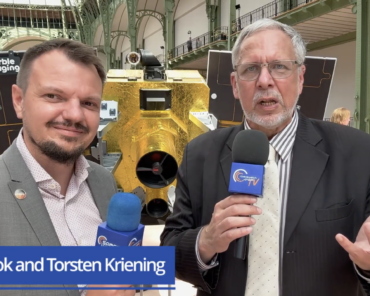
At DGI 2026 in London, SpaceWatch.Global publisher Torsten Kriening speaks with Peter Round, Head of Europe and VP Business Development, Defense & Intelligence at EarthDaily Analytics, about what changes when a fully calibrated, AI-ready satellite constellation enters commercial operations this summer.

With six additional satellites launching in April—completing a fleet of ten identical spacecraft in the same orbit—EarthDaily is delivering something the defence and intelligence community has never truly had before: global, daily, repeatable coverage designed from the ground up for automated change detection.
In this conversation, Peter Round explains why constellation design matters as much as analytics. Identical satellites, flying the same orbit, minimise jitter and maximise consistency—creating the ideal conditions for AI to reliably detect meaningful change at scale. Using a simple bridge analogy, he shows how daily revisit can reveal preparatory activity weeks before a capability is operational.
This is not an incremental improvement in ISR. It is a structural shift.
The discussion also reframes the role of the human analyst—not as someone supervising algorithms, but as a decision-maker finally freed from scanning thousands of pages of unchanged data. Instead, analysts can focus on interpretation, context, and action.
The conversation concludes with a look at sovereignty and resilience: how national data pipelines and sovereign cloud infrastructure respond to growing European demands for operational independence—and why global, always-on change detection is faster than traditional tasking models.
As Peter Round puts it: you don’t wait for a crisis to emerge. You are already watching everywhere, every day.