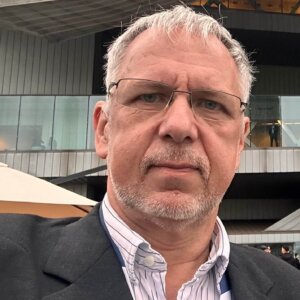
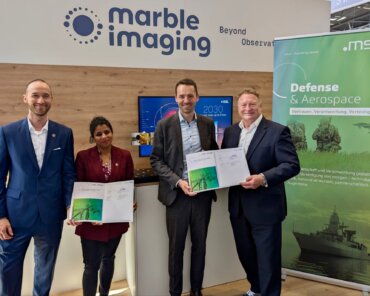
In the Space Café “33 Minutes With…” on Day 1 of ILA 2026 in Berlin, Nicola Kuhrt (Space.Table) explored how German NewSpace companies are re-reading the Earth – and why that capability has become strategic. Her guests were Dr. Gopika Suresh, Co-Founder and Chief Science Officer of Bremen-based Marble Imaging, and Dr. Thomas Heege, Founder and Managing Director of EOMAP, a pioneer of satellite-based water mapping since 2006 and now part of global geo-data leader Fugro.
You are currently viewing a placeholder content from YouTube. To access the actual content, click the button below. Please note that doing so will share data with third-party providers.
Both described an Earth observation sector transformed in just a few years. The opening of the Copernicus archive, the leap to very-high-resolution imagery down to 50 centimetres, and the rise of AI have turned satellite data into operational, predictive infrastructure – from forecasting coastal survey conditions to monitoring water quality, disasters and crises in near real time.
The discussion turned sharply strategic on data sovereignty. Suresh pointed to Europe’s reliance on non-European sources and the risk of access being restricted, making independent providers like Marble Imaging -and its planned constellation delivering hourly coverage – a matter of resilience. Heege welcomed strong space-agency and ESA support but called for a genuine industrial policy and faster public uptake, warning that billions in investment must translate into self-sustaining, globally competitive industry.
On dual use, both saw civilian and security needs converging, alongside obligations under Germany’s satellite data security rules. Yet their long horizon was clear: beyond today’s geopolitics, climate change remains the defining challenge – and the reason to keep watching the Earth.