In a demonstration of expanding commercial participation in the Asian space industry, fourteen Korean new space companies engaged the industry during K-Space Night, a pitching competition at the sidelines of the recently concluded Space Tech Expo in Bremen, Germany.
Linking Korean New Space Startups with global partners
The Korea AeroSpace Administration (KASA) is preparing for a major leap in Korea’s space industry and is set to drive the nation’s space industrialization while also strengthening private sector participation. K-Space Night’s pitching competition, – co-hosted by KASA – is thus one of the country’s broad national efforts to connect these promising startups with key players in the global industry, laying the groundwork for fruitful collaborations. The event gave the startups the opportunity to showcase their technologies while exploring new partnerships and collaboration opportunities.

Before the pitching began, Jongsun Park, Deputy Director, Ministry of SMEs and Startups, and Mijin Yoo, Deputy Director, Korea AeroSpace Administration (KASA) gave the welcome and congratulatory remarks respectively. Minseong Kang, Assistant Director at the Ministry of SMEs and Startups subsequently introduced the audience to Korea’s space and aviation industry and policies while Roberto Gemma of Ansys- presented a counterpart introduction to the European space industry during the event.
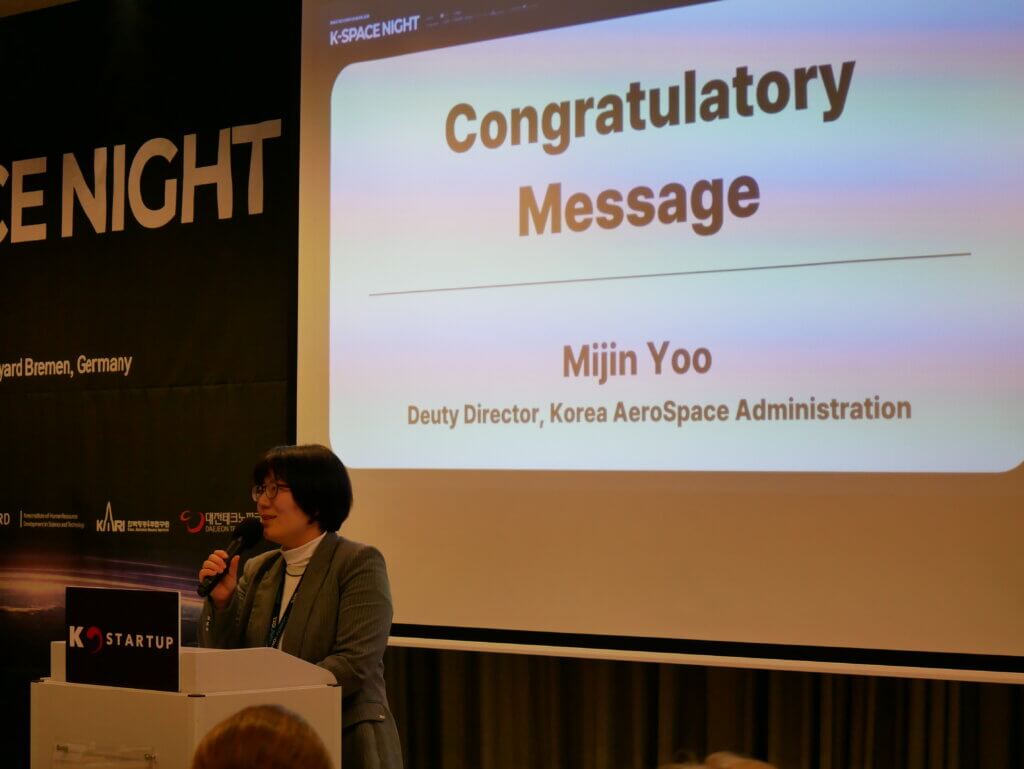
During her congratulatory remark, Mijin explained the importance and goal of the event, saying
“K-Space Night is part of a national effort to help Korean space startups connect with global partners and secure real opportunities from international communities. The event aims to link Korean space startups with German and European industrial and research communities.”
Pitching Competition
During the event, the startups pitched their respective value propositions in dedicated investor relations sessions as they look to fast-track their entry into the European market. One of the objectives of K-Space Night was, after all, to expand the participating startups’ commercial opportunities, helping them create long-term collaborations with leading space agencies and major aerospace and defense companies globally.
The fourteen participating startups took turns during the Investor Relations sessions to describe and explain their value offerings to the audience and judge, Spacewatch’s Laura Todd. Here are some of the interesting solutions that caught her eyes.
SPACEMAP (Space Domain Awareness and Space Traffic Management)
This Korean company, led by CEO Douglas Kim, is developing a real-time decision-making platform that enhances the safety, optimization, and intelligence of satellite constellations. SPACEMAP successfully completed its series A funding round earlier this year, and is channeling the funds to developing its Space-Time AI Platform.
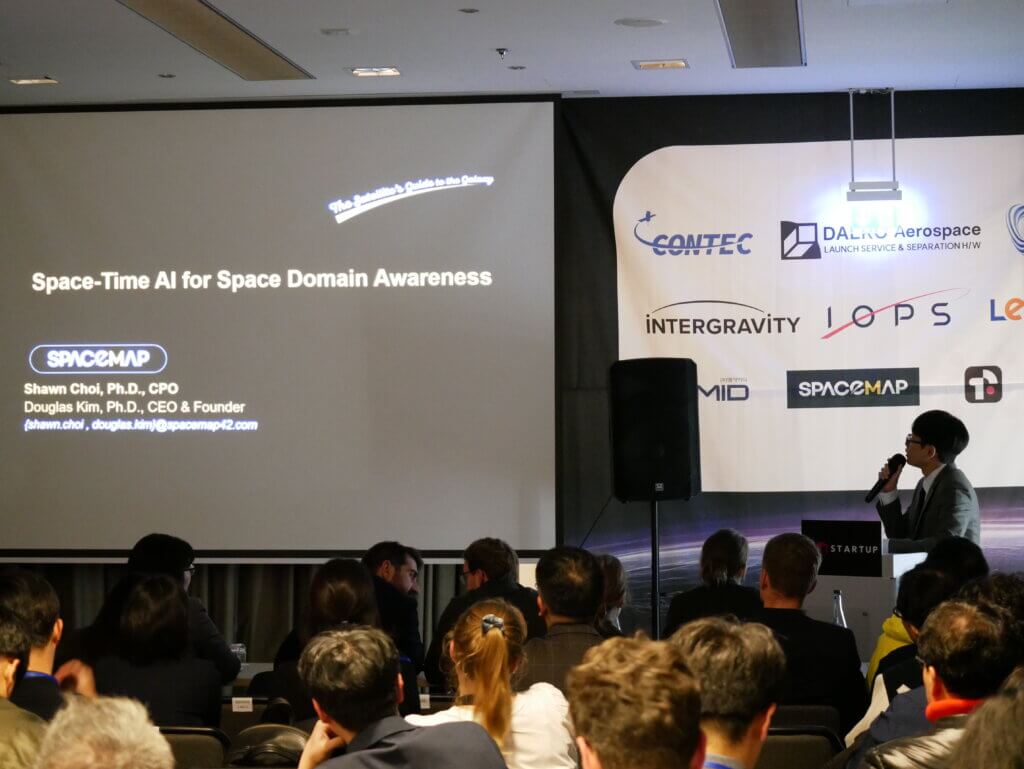
The startup’s Space-Time AI Platform creates a unified AI-driven system that can empower global satellite operators with precise collision prediction, optimal avoidance, and coordinated space operations. The Platform achieves this through a core engine that analyzes the orbits of space-based assets using high-precision real-time event simulation, security-constrained optimization, and AI-driven data analytics.
SPACEMAP has participated in multiple U.S. Space Force SDA TAP Lab acceleration cohorts, which are designed to address specific, pre-determined “What if” statements in space battle management to deny a space adversary the advantage of surprise. SPACEMAP’s participation in TAP Lab ensures its value offering cuts across different application fields; from Defense & Space Domain Awareness (SDA) and Satellite Constellation Operations to Space Safety Simulation and Education.
MADDE (Space manufacturing)
Pioneering binder jetting 3D printing manufacturing technologies, MADDE is another exciting Korean space startup. MADDE is developing high-performance silicon carbide and metal-based components for the semiconductor, space, Small Modular Reactor (SMR), and defense industries, leveraging in-house processes, from design to production. The startup layers Silicon Carbide with 3D printing, providing a cost-effective and quick manufacturing service for the space industry.
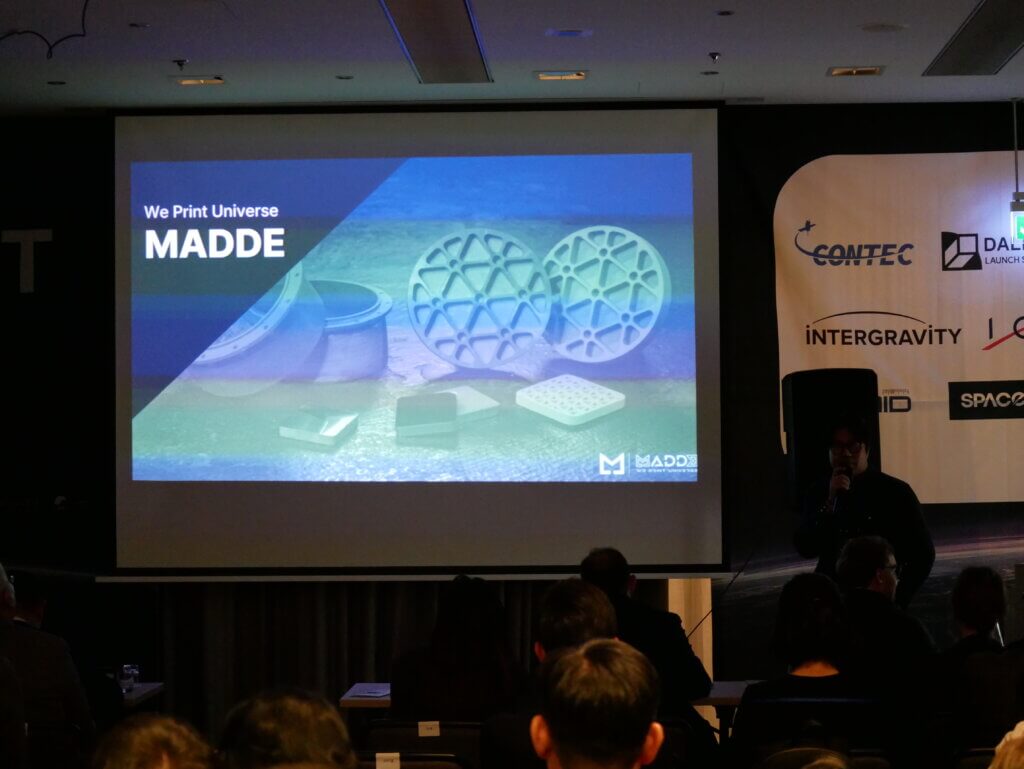
Led by CEO Shinhu Cho, the Hyundai Motor Company spin-off has raised a cumulative of USD 9.5 million in investment, using its funding to accelerate its development of wire-arc additive manufacturing-based metal (WAAM) additive technology, allowing the Korean startup to produce complex, high-strength components with lower cost and faster turnaround.
InterGravity Technologies (Orbital transportation services)
Led by CEO Keejoo Lee, InterGravity is addressing some of the challenges associated with rideshare launches, including separation instability, mission constraints from orbital injections, and time delays in reaching target orbit. The startup is going about this objective by providing orbital transportation services in form of last mile delivery, precise deployment, payload hosting, and deorbit/reentry services, potentially expanding commercial access to LEO, Lunar and beyond.
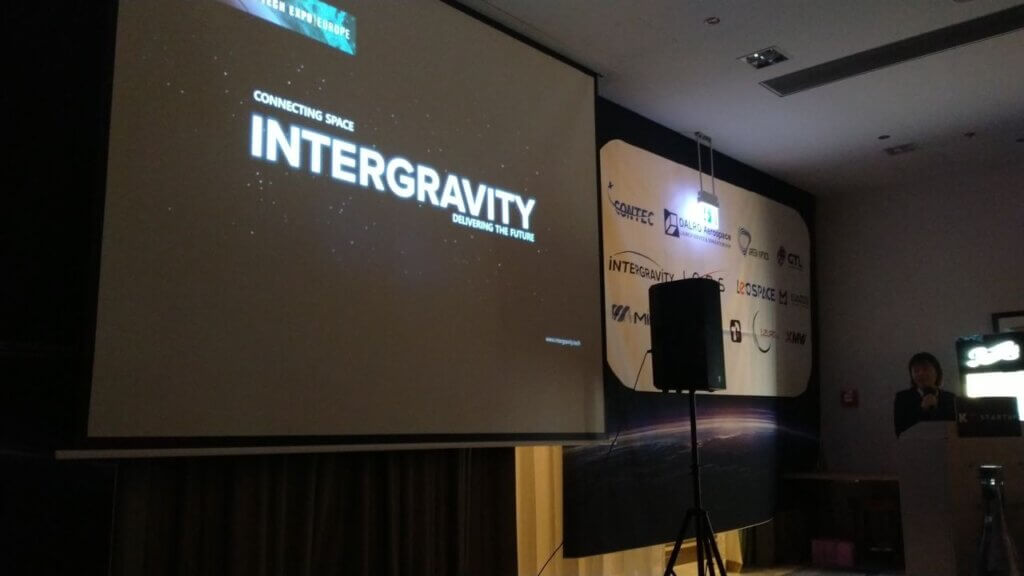
Offering a more practical solution to the limitations of rideshare missions, InterGravity is developing and will launch its first demo Orbital Transfer Vehicle (OTV) in 2027 on a SpaceX Falcon 9 rideshare program, unironically, to validate its value offering. InterGravity’s OTV will come in 50-KG and 500KG class sizes, and utilize green-propellant propulsion technology based on Nitrous Oxide/Ethane. The company will also rely on additively manufactured thrusters and lightweight Composite Overwrapped Pressure Vessel (COPV).
In furtherance of the startup’s mission and objectives, InterGravity has entered into multiple collaboration agreements with various institutions and organizations globally. In 2025 alone, the Korean startup has penned MoUs with JIRRA Enterprise Space of South Australia, Southern Launch in Australia, Space Exploration Engineering LLC in the U.S, and EnduroSat in Bulgaria.
Other participating startups
Besides SPACEMAP, MADDE, and InterGravity, other participating startups also pitched interesting value propositions during the investor relations sessions.
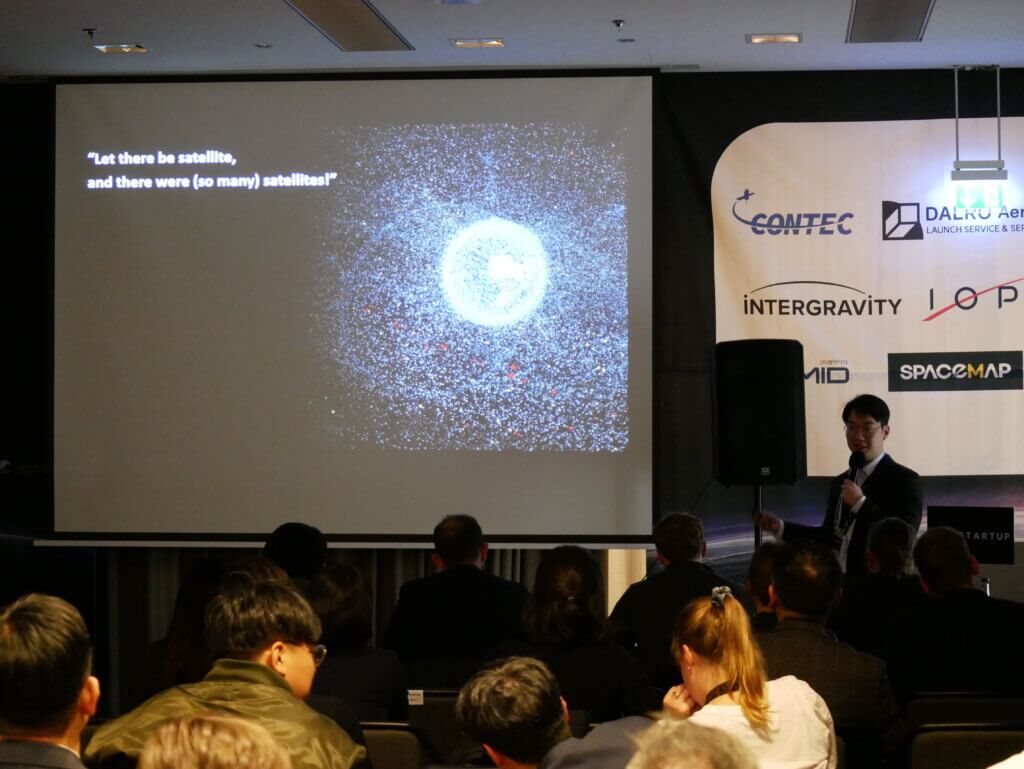
telePIX is building an AI LLM-based data processing platform; MID is working on end-to-end turnkey solutions for mission-critical, space-grade components; Leo SPACE is developing advanced optical payloads and miniaturized free space optical laser communication terminals for smallsats, and DALRO Aerospace intends to provide launch service pre-launch support, regulatory consulting, and end-to-end mission management services to the space industry.
In the same vein, IOPS engages in satellite operations, ground station deployment and services, and satellite Assembly Integration and Testing (AIT), CONTEC Space Group runs a network of 15 ground stations globally, while offering satellite manufacturing, AIT, and ground terminal services, and Green Optics covers everything from satellite design and manufacturing to system integration, specializing in advanced industries including defense, aerospace, and semiconductors.
Meanwhile, XMW possesses core competencies in advanced RF and mmWave technologies, focusing on Ka-band and simultaneous multi-band solutions for SATCOM, 5G/6G, and RADAR systems, and UZURO Tech is making the space environment more sustainable for future generations by delivering integrated Space Traffic Management solutions. Finally, GTL is developing a triple (S, X and Ka-Band) band feeder and a 3-axis, auto-tracking antenna system for low earth orbit applications, while Nara Space builds 16U small satellite platforms and satellite-data based applications.
Concluding remarks
Through K-Space Night and its broader participation in Space Tech Expo Europe 2025, Korea aims to deepen cooperation with European partners and enhance the global competitiveness of its nascent space startup ecosystem. With exciting solutions like orbital transport services, optical laser communication terminals, end-to-end turnkey solutions for mission-critical, space-grade components among others, K-Space night has laid the foundation for the germination of the Korean newspace industry. As the region takes root in the space arena, the global industry looks forward to remarkable milestones from the Asian country.