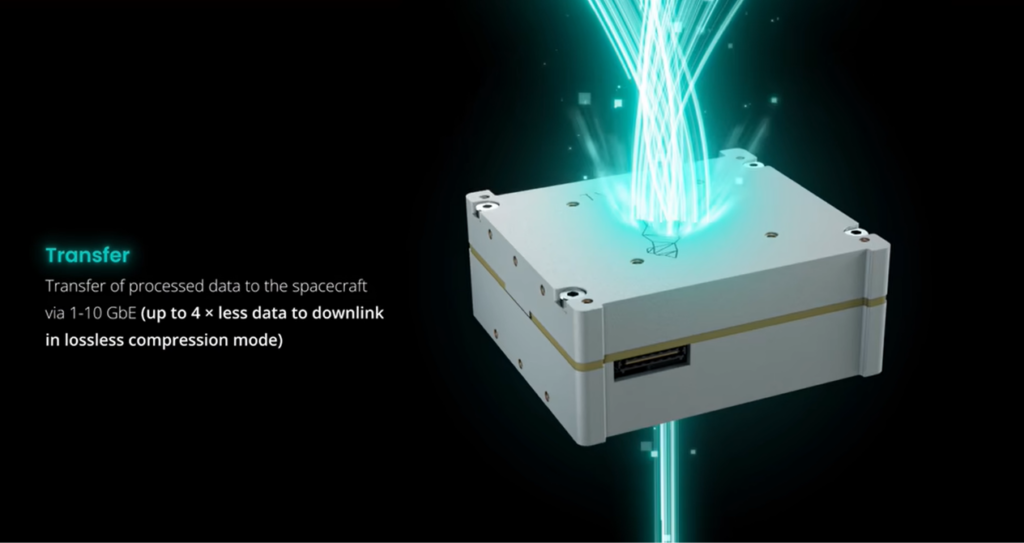
Lagos, 17 November 2026. – Polish space technology company KP Labs has unveiled Serval Nano DPU, a new onboard Data Processing Unit designed to manage the growing volumes of data generated by Earth observation satellites in low Earth orbit (LEO). The DPU will be on display at Space Tech Expo in Bremen, Germany.
Hardware deliveries are expected to begin in 2027.

Built around AMD’s Versal AI Edge architecture, the approximately 600-gram system integrates payload data acquisition, image preprocessing, hardware compression, artificial intelligence (AI) inference and redundant data storage. With a workload-dependent power consumption of 6.5–25 W, Serval Nano is designed to provide these capabilities within the mass, power and volume constraints of smaller spacecraft.
The growing need for onboard data processing
The system addresses a growing challenge in Earth observation: satellites can collect more data than they can transmit to Earth during available communication windows, while limited downlink bandwidth, ground station availability and onboard resources can delay the delivery of useful information to end users.
By integrating acquisition, processing, compression and storage, Serval Nano is designed to prepare and prioritize payload data onboard, reducing the volume of information that must be transmitted to the ground.
Integrating data acquisition and processing
Serval Nano DPU combines processing resources suited to different stages of payload data management, allowing imagery to be prepared and analyzed before storage or transmission. Its capabilities include image preprocessing, AI inference and CCSDS 123.0-B-2 lossless and near-lossless compression, alongside algorithms for image correction and cloud screening.
This is particularly relevant to multispectral and hyperspectral missions, which generate substantial volumes of data across multiple spectral bands. The system also features two 960 GiB NVMe solid-state drives (SSDs) in a cold-redundant configuration, allowing operators to retain both raw and processed data. For Earth observation operators, these capabilities can reduce the amount of data competing for limited downlink capacity.
Serval Nano also supports camera data acquisition at approximately 20 Gbps and can reduce the volume of information requiring transmission by up to four times through lossless compression. Its storage capacity can accommodate processed imagery covering approximately eight million square kilometers at a one-meter ground sampling distance (GSD) and eight bits per pixel in lossless compression mode. This allows satellites to retain substantial observation datasets while prioritizing the information transmitted to ground stations.
Adapting satellite processing capabilities in orbit
Another key feature of Serval Nano is its ability to support changes to processing functions after launch. Using the reconfigurable capabilities of the Versal AI Edge architecture, operators can update onboard software, AI models and programmable logic bitstreams during orbital operations. This allows missions to introduce improved algorithms or adapt data-processing workflows without replacing hardware.
To support these updates, the system incorporates redundant NOR boot flash, an independent supervisor for health monitoring and fault recovery, and additional safeguards against memory and configuration errors. According to the company, the unit is designed to withstand total ionizing radiation doses above 20 krad, The DPU will undergo qualification for launch and space environmental conditions at NASA General Environmental Verification Standard (GEVS) levels.
Modular architecture for payload flexibility
Serval Nano expands KP Labs’ onboard processing portfolio alongside its Leopard DPU, which remains available for missions with different processing requirements. The company provides the new unit alongside configurable interface boards, ground-support equipment and associated software and algorithms, allowing it to be adapted to different payloads without redesigning the core processing architecture.
Beyond Earth observation, potential applications include autonomous navigation, scientific missions involving multiple instruments and in-orbit technology demonstrations. Designed, integrated and supported in Europe, Serval Nano is intended to give satellite manufacturers and emerging Earth observation companies access to an integrated processing system without requiring extensive in-house hardware and software development.
“For most Earth observation missions, the limit is no longer how much a satellite can see, but how much of it ever becomes useful on the ground. Data movement, not raw compute, is the real bottleneck,” explained Michał Gumiela, CTO of KP Labs. “With Serval Nano we wanted data to start working the moment it leaves the sensor: acquired, corrected, compressed and analyzed on board, in one unit. And because no mission stays the same for years, every part of that chain can be changed in orbit.”