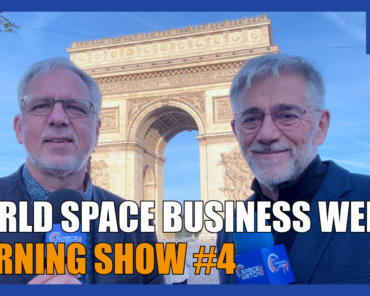
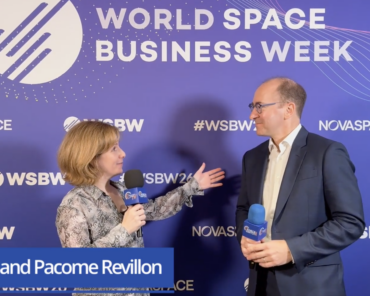
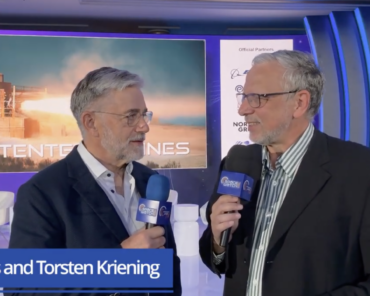
From the Grand Palais in Paris, Torsten Kriening opens SpaceWatch.Global’s interviews at the first International Space Summit with Adel Haddoud, CEO of Infinite Orbits — and with news that had reached the international press only minutes earlier.
You are currently viewing a placeholder content from YouTube. To access the actual content, click the button below. Please note that doing so will share data with third-party providers.
A second European satellite operator has signed for Endurance, the company’s satellite life-extension service. For Haddoud, that milestone says a great deal about where the in-orbit servicing market now stands. Two years ago, he notes, the majority of satellite operators were still discovering life extension — what it involved, whether it made sense, and how much risk it carried. Today, operators know the service, understand the missions and the concept of operations, and are familiar with Endurance itself. The result is a repeatable business at genuine scale, and a far easier conversation with prospective customers, who are buying a demonstrated product rather than a promise.
That scaling ambition is precisely why Infinite Orbits opened its new Assembly, Integration and Testing facility in Toulouse, announced the previous day. Asked what comes next, Haddoud is direct: the company needs more people and more capital, though the customers and the market demand are already there. The AIT facility, he explains, lets Infinite Orbits show operators how quickly it can deliver — building considerable trust in the process. New offices in Munich, announced six months earlier, are also growing well.
Haddoud returns repeatedly to Europe, and to a point that clearly matters to him: Endurance is built with parts from 17 different European countries, including Germany, France, Luxembourg and the UK, leveraging the best the continent has to offer and creating real independence and autonomy in manufacturing. Yet the business itself is unmistakably commercial, with around 90% of customers on the commercial side and sales extending to South America and Asia. This, he emphasises, is not a mission-by-mission institutional effort but a scalable product with global demand.