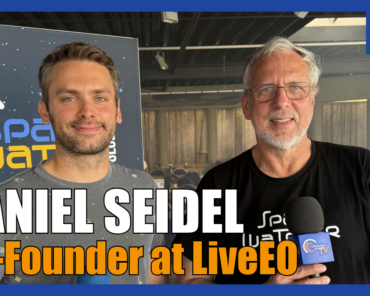
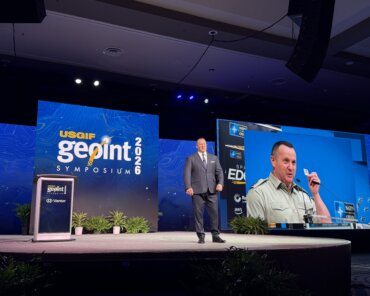
At GEOINT 2026 in snowy Aurora, Colorado, Torsten Kriening spoke with Daniel Seidel shortly after LiveEO announced its €28 million Series B2 funding round.

The investment is not tied to the company’s Twin Specter satellite program, which is financed separately. Instead, the focus is on strengthening LiveEO’s analytical platform, AI capabilities, and expansion into both infrastructure monitoring and defense applications.
What stood out in the conversation was not the funding itself, but the pace at which AI workflows are changing.
LiveEO has worked with AI and satellite imagery for years. According to Seidel, the last few months have altered development processes more dramatically than the previous decade. The shift comes from agentic AI systems capable of handling large parts of software development workflows autonomously. Tasks that previously moved between teams can now be executed in sequence by AI agents, with humans increasingly stepping back into supervisory roles.
For Seidel, the key change is where human input happens.
Less in implementation.
More in deciding what should be built in the first place.
That has implications beyond software teams. It affects hiring, procurement, and ultimately competitiveness. LiveEO is currently expanding across Germany, the United States, and Brussels, including hires with defense and military backgrounds.
His impression of GEOINT 2026 reflected a broader concern.
The United States appears significantly ahead in connecting AI, defense, and operational workflows into a functioning ecosystem. Conversations around agentic development and AI-enabled workforces were widespread in Colorado. In Germany, he noted, those discussions remain far less visible.
At the same time, Seidel argues Europe no longer has the luxury of hesitation.
Not because the technology is unavailable.
Because the timelines are shrinking.