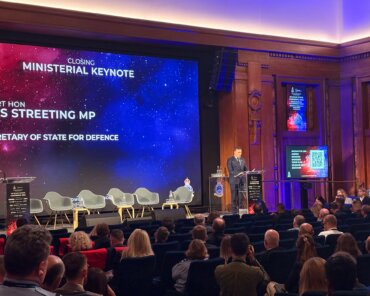
Aurora – 5 May 2026 – The 2026 USGIF GEOINT Symposium opened in Denver this week, drawing thousands of professionals from government, industry, and academia to explore how artificial intelligence, commercial capabilities, and international partnerships are reshaping the geospatial intelligence tradecraft.
USGIF CEO Ronda Schrenk welcomed more than 200 exhibiting organizations, 230 speakers across 151 sessions, and over 410 international guests from 26 countries. Notably, 57 academic institutions participated, underscoring the symposium’s focus on workforce development. Schrenk highlighted that AI was a recurring theme across nearly every session submission, signaling its pervasive role in modern GEOINT.
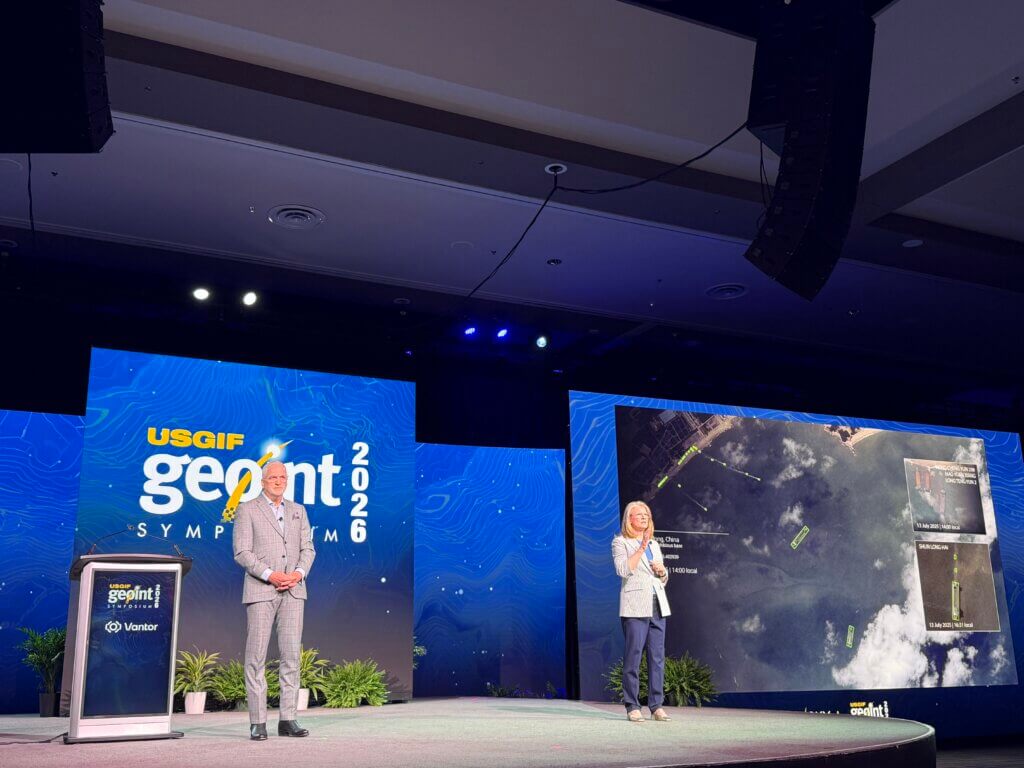

USGIF Chairman Robert Cardillo, alongside Schrenk, showcased mission-impact vignettes from across the community. Highlights included BlackSky’s detection of coordinated Chinese amphibious activity, ICEYE’s SAR-based monitoring of Iranian nuclear sites following Operation Rising Lion, Janes’ fusion of RF interference and satellite imagery to map Russian force protection in Ukraine, and Starboard Maritime Intelligence’s “Operation Night Watch” with the Marshall Islands, which slashed vessel detection-to-verification times from days to hours. Other featured capabilities came from Vandor Labs and Google, Safran Federal’s HyperReveal, Whitespace’s GPS jamming detection, Muon Space’s FireSat constellation, Urban Sky’s high-altitude balloon ISR, and Aurelia’s CHIRRX agentic constellation orchestration.
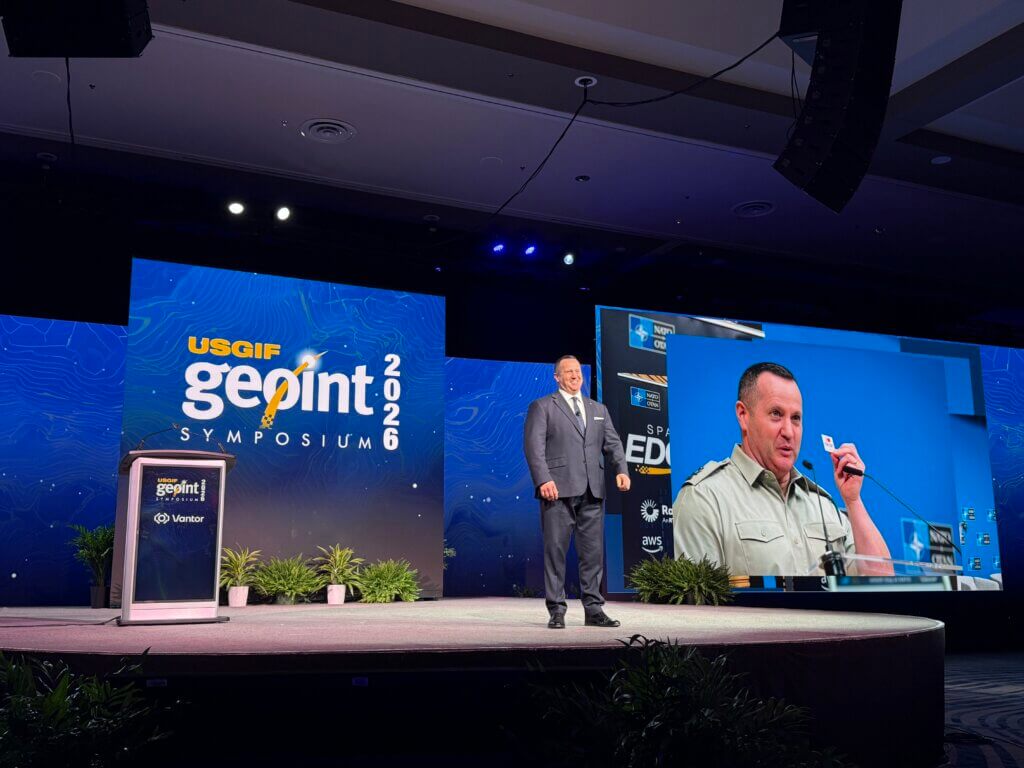
NATO Keynote: The Integration Imperative
Major General Paul Lynch, NATO’s Deputy Assistant Secretary General for Joint Intelligence and Security, delivered a powerful keynote on allied intelligence challenges. He emphasized that NATO members increased defense spending by roughly 20% in 2025-the fastest pace since the Cold War- with all allies committing to a 5% GDP target by 2035. Lynch stressed that recent intelligence failures supporting Ukraine were “almost never collection failures” but rather integration failures, calling for sharing-by-default policy frameworks, common AI and data standards, and deeper allied working relationships. He singled out NGA’s Luno program as a model for incorporating commercial GEOINT.
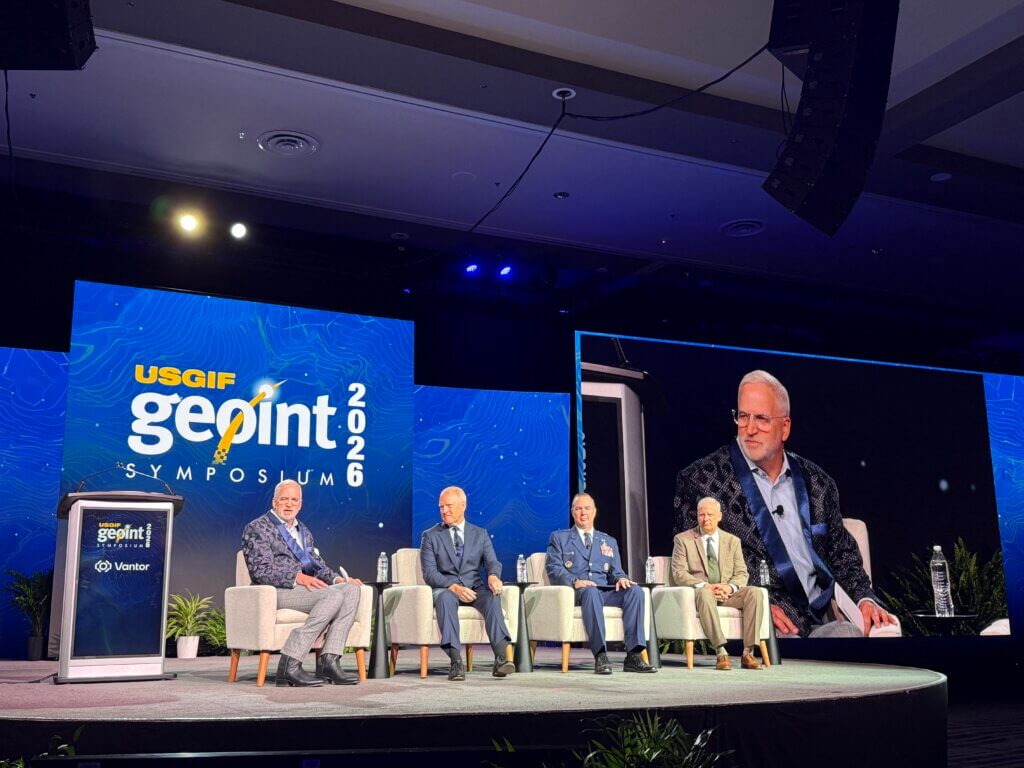
Operational and Technology Panels
A senior leadership panel featuring Brigadier General Steven Gorski (NORAD/NORTHCOM J2), Vice Admiral (ret.) Frank Whitworth, and Lt. Gen. (ret.) Scott Berrier addressed homeland defense challenges, AI trust, and the AGMTI mission. Gorski emphasized transparency, integration, speed, and persistence as core requirements.
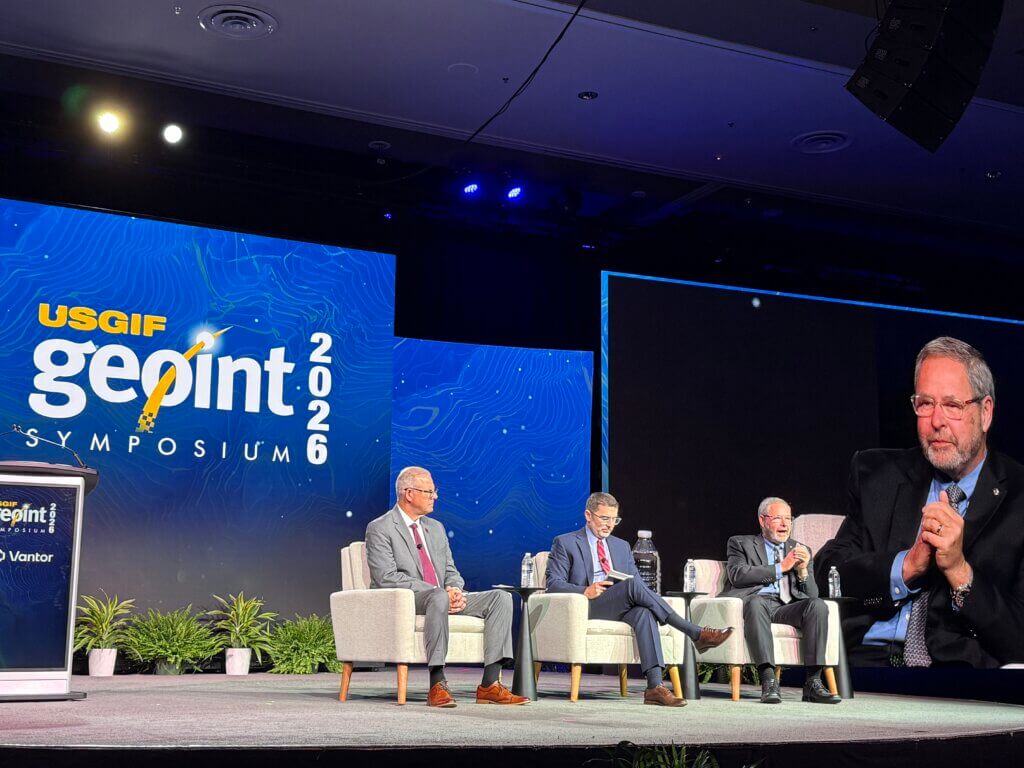
A subsequent CIO panel with IC CIO Doug Cossa and NGA CIO Mark Chatelain explored zero trust implementation, edge computing in DDIL environments, and scaling AI infrastructure – reinforcing that technology is no longer a support function but the mission itself.