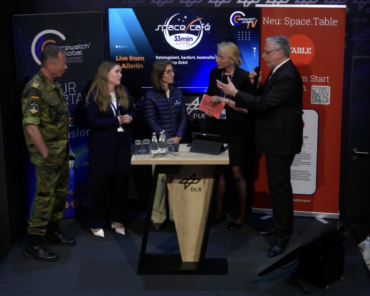
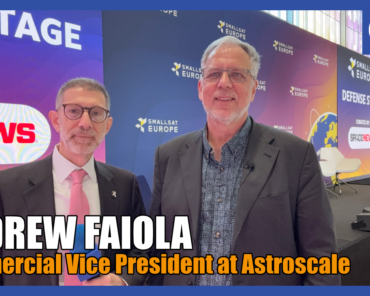
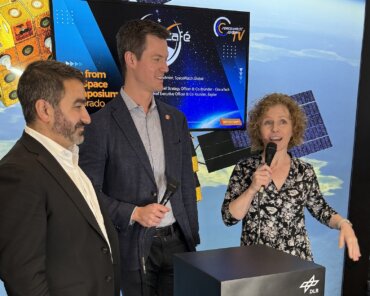
At Space Symposium 2026, Laura Todd spoke with Nick Shave, Managing Director of Astroscale UK, about the growing urgency of orbital debris removal and the emergence of a commercial market around it.
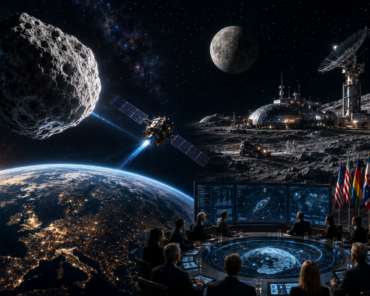
With more than 11,000 tons of debris accumulated in orbit, the challenge is no longer theoretical. The question is how quickly the industry can act to ensure the long-term viability of low Earth orbit.

Astroscale is positioning itself at the center of this effort. Through missions such as ELSA-d and ADRAS-J, the company is developing and demonstrating active debris removal capabilities. This includes work with JAXA to safely deorbit a large rocket body, as well as preparations for future servicing missions like ELSA-M, which will support satellite operators in maintaining and extending the life of their assets.
A key element of this approach is standardization. Astroscale’s docking plate, a small but critical component, is already being integrated across multiple spacecraft, enabling future servicing and removal missions at scale.
The implications go beyond sustainability. In-orbit servicing is becoming increasingly relevant for both commercial operations and defence applications, as space infrastructure grows in importance.
At the same time, the conversation reflected a broader perspective. As human spaceflight returns to the forefront with missions like Artemis II, the need to protect and manage the orbital environment becomes even more pressing.
Astroscale’s vision is clear. Building a sustainable space economy is not just a technical challenge. It is a responsibility that will shape the future of space for generations to come.