by Torsten Kriening, Publisher, SpaceWatch.Global
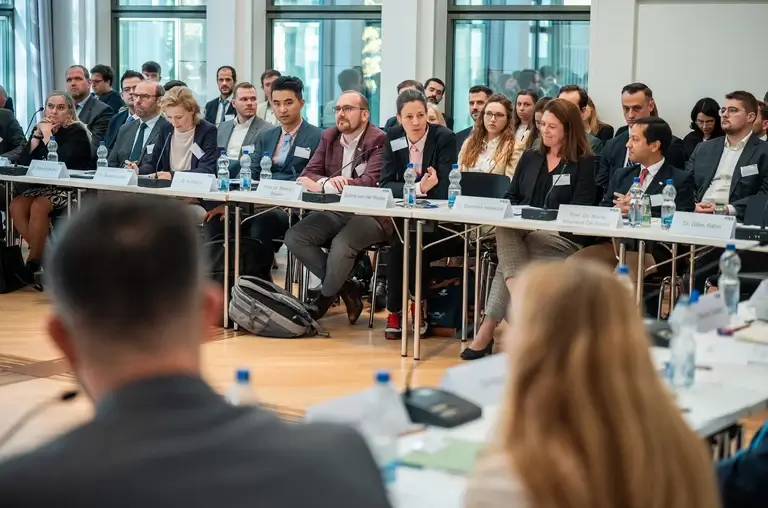
The International Security Forum Bonn 2025 followed by the Bonn Future Lab on Strategic Foresight 2025 was not just another date on the space conference calendar. It was a cold, hard reality check. Over two intense workshop-days and one conference day of debate and scenario-building, one message sliced through the polite veneer of diplomacy: Europe still has the assets to remain a global player in space, but our clock is ticking, our coordination is fraying, and our political courage is running dangerously thin.
Federal Minister Dorothee Baer for Research, Technology and Space (BMFTR) served as the patron of the conference, signaling a high-level recognition of the urgency at hand

At SpaceWatch.Global, we’ve seen countless “visionary” gatherings, but Bonn felt different. It was defined by a rare, uncomfortable honesty. Industry, security, and governance were no longer treated as parallel silos; they were addressed as the three inseparable legs of a tripod supporting Europe’s future.
The Pandemic of “Space Blindness”
If there was a central theme that unified every keynote and workshop, it was the concept of “space blindness” (Weltraumblindheit). Coined by Dr. Enrico Fels of CASSIS, this term describes the persistent, dangerous tendency of both the public and politicians to treat space as a peripheral realm – a playground for engineers and billionaires rather than a central concern for national strategists.
We are living through a paradox. Our modern civilization is built on a foundation of orbital glass. Our societies depend on space for communication, navigation, finance, logistics, climate monitoring, and defense. Space is the “invisible backbone” of modern life, essential for achieving more than half of the UN Sustainable Development Goals. Yet, in Germany, among nearly 16,000 professorships in law, social sciences, and economics, there is only one chair for Space Law – and none for Space Security or Space Economics. As Dr. Fels noted, this academic and political negligence is “indefensible and inadvisable”. If we cannot see the importance of the domain, we cannot hope to protect it.
The Diagnosis: We Know the Problem
The diagnosis delivered in Bonn was consistent and sobering. From Matthias Wachter’s call to treat space as a core engine of economic growth to Major General Michael Traut’s blunt assessment of orbit as a contested security nexus, the verdict is in: space has graduated from being a “nice-to-have” enabler to becoming the primary infrastructure of sovereignty.
As Matthias Wachter, Managing Director of the NewSpace Initiative at the BDI, pointed out:
“Those who are not competitive in orbit will lose sovereignty in key areas on Earth.”
The Lab exposed a structural mismatch that should keep every policymaker in Brussels and Berlin awake at night:
- Fragmentation vs. Scale: While the U.S. successfully fuses venture capital, aggressive procurement, and national security into a single, high-speed flywheel, Europe is still tripping over its own borders and duplicating efforts across institutions.
- The Speed Deficit: Our bureaucratic procurement cycles and risk-averse funding models are moving at a 20th-century pace in a 21st-century race. In the current space economy, if you aren’t fast, you’re irrelevant.
- Strategic Dependence: From launch access to critical technologies, Europe remains vulnerable exactly where it needs autonomy most.
The workshop’s foresight scenarios for 2040 weren’t just academic exercises; they were a fork in the road. Participants identified seven key factors that will decide our fate, including the global geopolitical situation, the militarization of space, and the progression of AI. One path leads to a European success story of resilience; the other leads to strategic obsolescence. The difference between those two futures won’t be decided by our engineers – it will be decided by our politicians’ ability to cure their own space blindness.
The Pivot: From Dominance to Superiority
Perhaps the most sophisticated outcome of the Lab was the intellectual shift away from the idea of “space dominance.” For Europe, dominance is a mirage. Instead, the consensus converged on Space Superiority.
This isn’t just a semantic tweak. Superiority means the capability to act, protect, and decide independently while remaining a credible partner on the global stage. Europe’s “unfair advantage” isn’t brute force; it’s our commitment to governance, sustainability, and norms. Debris mitigation and responsible behavior aren’t “soft” issues – they are instruments of power in a contested domain. If Europe sets the standards for a sustainable orbit, Europe leads.
Case Study: The Ukraine Wake-Up Call
For those who still believe space is a distant concern, the war in Ukraine serves as a brutal corrective. Moscow nearly succeeded in “blinding” Kyiv at the start of the invasion. Only the rapid deployment of commercial constellations like Starlink and the “unblinking eye” of Western earth-observation networks allowed Ukraine to communicate and coordinate its defense. This “humiliating experience” for Russian strategists has already led to calls for enhanced counterspace operations to disrupt and destroy enemy assets – even potentially using nuclear devices in orbit. This is no longer science fiction; it is the front line of modern conflict.
The Action Plan: Moving the Needle
The Bonn Future Lab produced a roadmap for survival. If we are to bridge the gap between foresight and execution, five things must happen immediately:
- Governments Must Buy, Not Just Build: The state must become an anchor customer. Public procurement and fast-track demonstrators are the only ways to scale European startups into global champions.
- Design for the Fight: Resilient, multi-orbit architectures are non-negotiable. Redundancy and protection must be baked into our systems from day one, not added as an afterthought.
- End the Dual-Use Taboo: Security and commercial space are now one and the same. We must stop treating dual-use as a risk and start treating it as our reality.
- Governance as a Strategic Asset: The EU Space Act has the potential to become a global gold standard – but only if it fosters a competitive market instead of strangling it with red tape.
- Invest in Strategic Thinking: Technology alone is not enough. We must strengthen our academic institutions and think tanks to provide the astropolitical and legal reflection needed to match the strategic depth of the US and China.
The Bottom Line
My takeaway from Bonn is this: across Europe’s space sector, we are finally aligned on the “what.” We are even beginning to understand the “why.” But we are still paralyzingly hesitant on the “how fast.” As Dr. Gerald Braun, Head of Division for Security and Special Assignments at the German Space Agency, concluded his keynote:
“I would therefore be delighted if you would all work together… to ensure that space remains sustainably accessible for future generations, for our children and grandchildren.”
In today’s geopolitical climate, money is no longer the primary constraint. Time is.
The “Grey Rhino” of the Kessler Syndrome – a catastrophic chain reaction of space debris – is looming on the horizon, not as a wild card, but as a predictable consequence of our current inaction. Space is already dictating our economic resilience and our military credibility on Earth.
The window to shape the rules of the game is narrowing. Foresight is a gift, but without execution, it is just a hallucination. We must cure our space blindness now, or we will be forced to watch our future disappear into the darkness of an orbital blackout.
The choice to lead or follow is still ours – for now.
Discover the Full Strategy: The insights shared in this piece are only a fraction of the strategic depth found in the official report, “Bonn Future Lab on Strategic Foresight 2025: Securing a Sustainable Space.“ From detailed geopolitical scenarios for 2040 to in-depth technical reflections on space law and dual-use technologies, this document is a vital resource for anyone serious about the future of European sovereignty. I highly encourage our readers to dive into the full 138-page report to understand the complexities and the solutions proposed by Europe’s leading space minds.