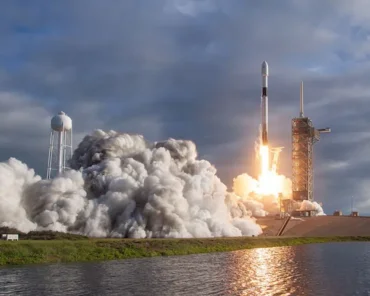
On the final day of Space Tech Expo Europe in Bremen, Laura Todd sits down with Chad Brinkley, CEO and founder of SEOPS, for a conversation about one of the sector’s most pressing constraints: access to space.
SEOPS was built to address the capacity crunch in dedicated rideshare. The company began in the International Space Station programme, which Brinkley credits with teaching them to do things the right way, before developing a CubeSat deployment system that helped ignite the CubeSat revolution around 2019. It went on to help build SpaceX’s rideshare programme, and by 2023 had concluded that the industry was heading into a period in which supply would be limited while demand became almost incomprehensible – a challenge he frames positively, as evidence of a thriving market, pointing to how the Bremen show itself has outgrown its building in just three years.
The company’s response is to position itself as a leader in the access layer, providing kilograms to orbit across a portfolio of rockets. Drawing on experience from 18 Transporter missions, Brinkley identifies three elements required to do that successfully. The first is a rocket programme: SEOPS runs the Waymaker programme, which is rocket-agnostic and defined instead by destination, in this case low Earth orbit. The second is critical infrastructure in the form of payload processing facilities – a home for customers who may spend 30 or 45 days on the road, where comfort matters, not least the coffee during ten-hour clean room sessions. That facility work is also an intensive logistics exercise, since integration windows at launch vehicle providers are limited and everything must align for a spacecraft to reach the rocket and fly.
The third element is an intelligent system designed to deliver the best possible customer experience in a high-stress environment. Called Lattis, it is built not as an AI layer over spreadsheets but for complete transparency, so customers always know where they stand against their deliverables and can easily raise questions – including the many that fall outside the interface control document and must be resolved between integrator and launch provider for a mission to execute. As Todd observes, it amounts to a common-sense focus on user experience and clean end-to-end data management.
On what comes next, Brinkley points to three Falcon 9 rockets secured across 2028 as part of the Waymaker programme, which he regards as an ignition point toward flying across multiple vehicles. Four different rockets were purchased at the show itself, Waymaker 3 was announced, and a larger Falcon 9-equivalent vehicle is lined up for a 2029 launch window. The underlying aim is to give the community the ability to plan effectively, ideally 36 months ahead – alongside a broader argument for genuine rocket diversification as the market evolves.