Written by Novi Dewan
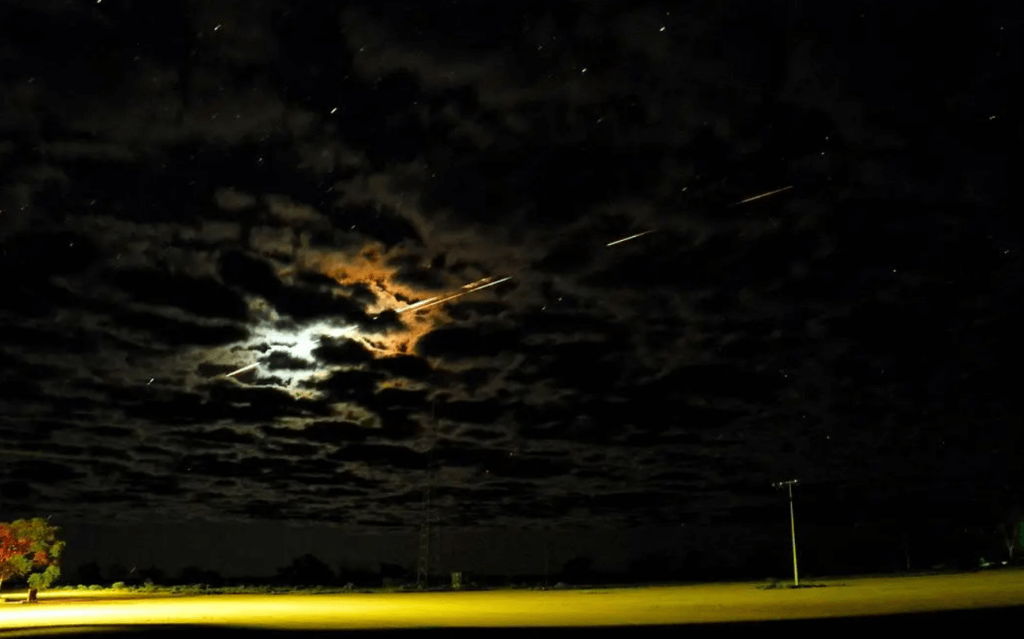
Article 1, What Happens in Space Better Not Stay in Space, unpacked how the Summit for Space Sustainability, convened by the Secure World Foundation in Paris, created alignment around the urgent need for coordinated action in orbit. This second article shifts focus from orbit to the thin, delicate layers far above us, where satellites end their lives and where new scientific signals are beginning to emerge.
Every object we launch must eventually return: burning, melting, vaporising into particulates that join the upper atmosphere. Until recently, these processes were largely unstudied. At the Summit, the “Clearing the Air” spotlight talk and panel revealed how early we still are: the evidence is intriguing, the mechanisms uncertain, and the need for scientific collaboration undeniable.
As Dr. José Ferreira cautioned, these are signals, not conclusions.

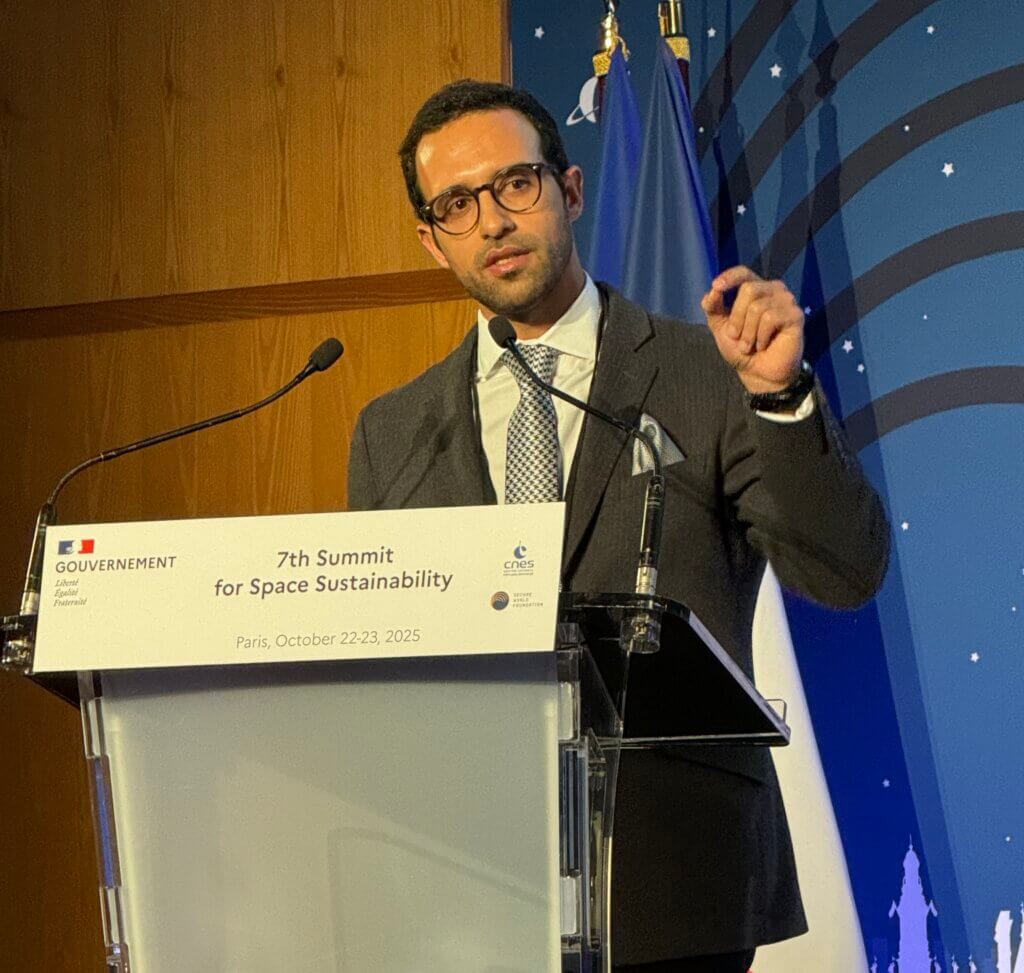
(1) Spotlight Talk – Clearing the Air: Understanding and Engaging on Possible Atmospheric Impacts of Space Activities
Speaker: Dr. José P. Ferreira, Researcher, University of California
Dr. José Ferreira presented one of the Summit’s most scientifically provocative sessions, exploring how the accelerating pace of launches and re-entries could be leaving measurable traces in Earth’s upper atmosphere. He cautioned, however, that this field of study is still in its early stages: the available data are limited, and more research is urgently needed to confirm and quantify potential impacts.
Ferreira explained that every space mission interacts with the atmosphere twice: during launch, when exhaust gases are injected vertically through its layers, and during reentry, when spacecraft and rocket stages burn up, releasing particulates and metal vapors. He noted that both phases must be studied together to understand cumulative environmental effects.
Presenting comparative data, Ferreira showed that the growing mass launched into orbit is now mirrored by a surge in re-entries. By 2024, his analysis found that anthropogenic aluminium from re-entering spacecraft likely surpassed natural meteoritic aluminium with 95 percent statistical confidence, marking a shift in atmospheric composition. He was careful to clarify that “this doesn’t mean the impact is negative, but it does mean we’ve changed the status quo.”
He outlined three primary methods of investigation:
- Remote sensing, used to detect byproducts such as aluminium oxides during ESA’s Cluster II and Cygnus OA re-entries.
- In-situ sampling, such as a 2023 Alaskan campaign that found up to 10 percent of aerosols containing spacecraft-derived metals. Ferreira cautioned, that largescale direct (in-situ) measurements at mesospheric altitudes remaining challenging.
- Laboratory simulations, replicating re-entry ablation in wind tunnels to study how materials melt, fragment, and transform chemically under extreme heat.
Ferreira outlined potential consequences under study, including radiative effects, ozone chemistry, and high-altitude cloud seeding. He stressed that these hypotheses remain unconfirmed, because the outcomes remain uncertain, but the anthropogenic signature is now real.
To reduce the uncertainty, he called for standardized re-entry scenario modelling, a baseline inventory of atmospheric chemical species, and stronger international coordination, to ensure consistent research and policy responses. His talk set the stage for the panel discussion that followed on how to advance this emerging research frontier responsibly.
Key Insights / Takeaways
- Early-stage research: Evidence of anthropogenic effects on the upper atmosphere is intriguing but not yet conclusive.
- Data validation needed: Only limited in-situ and laboratory data exist, underscoring the need for standardized re-entry studies.
- Dual-phase impact: Both launches and re-entries must be analysed together to assess cumulative atmospheric effects.
- Collaborative science: Shared models, global data collection, and international cooperation are critical to advancing understanding.
- Precaution through knowledge: Before regulation or mitigation, the field must first strengthen its scientific foundations.
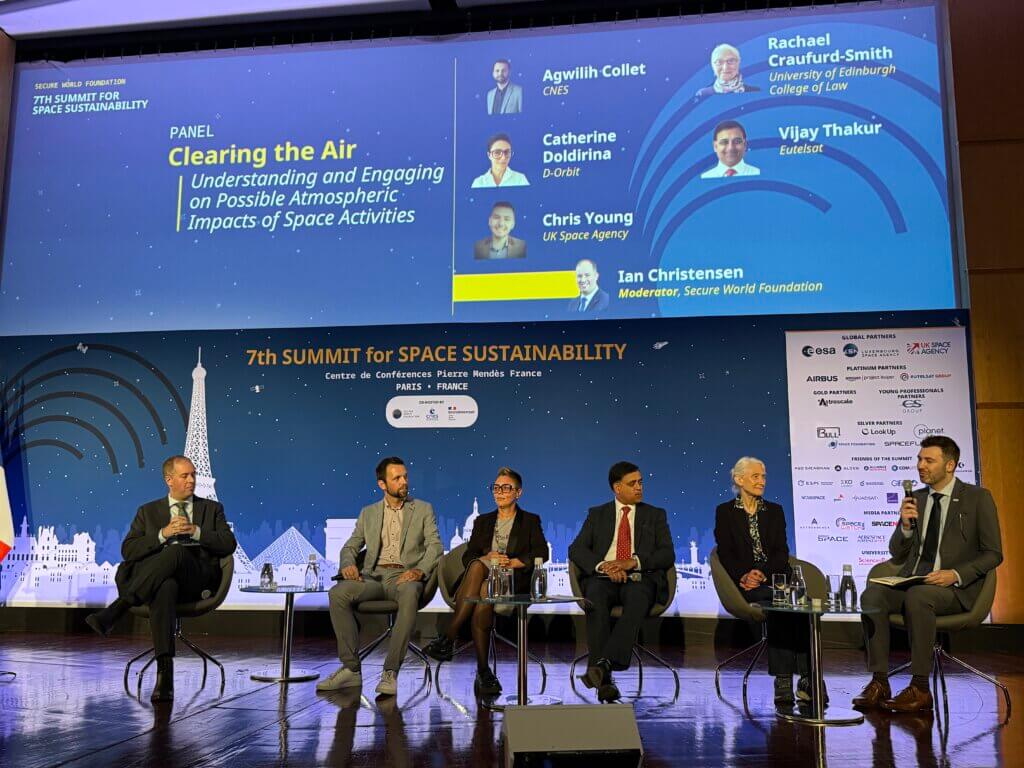
(2) Panel: Clearing the Air: Understanding and Engaging on Possible Atmospheric Impacts of Space Activities
Moderator: Ian Christensen, Secure World Foundation
Panelists: Rachael Craufurd-Smith (University of Edinburgh), Agwilh Collet (CNES),
Chris Young (UK Space Agency), Catherine Doldirina (D-Orbit), Vijay Thakur (Eutelsat)
Building on Dr. José Ferreira’s findings that anthropogenic aluminium from satellite reentries now exceeds natural meteoritic sources, the panel explored how science, regulation, and industry can respond to this first measurable human footprint in the upper atmosphere.
Research and Data Gaps
Chris Young of the UK Space Agency said the challenge began with a knowledge gap: “We must act responsibly, but we simply didn’t know the impacts.” The UK commissioned four studies spanning literature review, atmospheric chemistry, ablation modelling, and hybrid policy approaches. The work confirmed a severe shortage of validated data, leaving regulators unable to create evidence-based standards.
Launch Emissions and Atmospheric Effects
Agwilh Collet of CNES addressed launch emissions, noting that propulsion type and engine chemistry determine ozone and radiative effects, but “the question is—how much?” Under France’s Space Act, operators must now report emissions by atmospheric layer. “We may warm the stratosphere,” she said, “but we don’t yet know how that connects to the troposphere.”
Legal Frameworks and Policy Integration
Rachael Craufurd-Smith highlighted how space law has traditionally emphasized coordination and safety rather than environmental consequences. She pointed to fragmented data collection, overlapping mandates among COPUOS, ITU, UNEP, and others, and the absence of harmonized legal guidance. The 2021 International Law Commission guidelines, she argued, offer a pathway for integrating space and environmental law.
Industry Perspective and Operational Challenges
Vijay Thakur of Eutelsat captured the operator’s dilemma candidly: “I am lost. As a responsible operator, I don’t know what to do.” With de-orbit timelines shortened from 25 to five years, operators must move faster while uncertain about atmospheric outcomes. Current demise models assume full ablation, “but we don’t actually know if that’s true.” He proposed three steps: share aggregate material data, install onboard sensors that transmit until disintegration, and expand spectroscopic and radar observation of re-entries. “Our tools rely on numbers we don’t actually know,” he said.
Circular Economy and Industry Solutions
Catherine Doldirina described D-Orbit’s ION Satellite Carrier, which hosts multiple payloads in one vehicle, reducing total launches and re-entries. Forthcoming EU rules for environmental footprint audits, she added, will drive greater transparency. A circular economy in space, enabled by in-orbit servicing and reuse, “is real but not immediate.”
Policy Principles and Next Steps
Craufurd-Smith returned to environmental law’s precautionary principle: even with uncertainty, states have a duty to assess, cooperate, and mitigate. Young noted that only seven re-entries have ever been measured in situ, illustrating the scale of the unknown.
The panel closed with practical next steps: cross-agency technical exchange (Young); a French-led initiative to characterize upper-atmosphere impacts (Collet); onboard sensors and data transparency (Thakur); UNEP coordination (Craufurd-Smith); and industry-led audits (Doldirina). Christensen concluded that uncertainty cannot justify inaction: the evidence may be limited, but the responsibility to coordinate is clear.
Key Insights / Takeaways
- Data gap: Only seven in-situ re-entry measurements exist; data collection remains the field’s biggest bottleneck.
- Fragmented oversight: Science, regulation, and policy remain siloed, and harmonization under the UN Environment Programme could unify standards.
- Launch and re-entry: Both affect the atmosphere; emissions alter ozone and radiation balance, while re-entry adds metallic particulates.
- Transparency first: Aggregate material reporting and onboard sensors are practical steps that protect proprietary data.
- Precautionary action: States must investigate and act despite uncertainty, as seen in ozone and climate frameworks.
- Balanced design: Safety-focused deorbit rules should evolve to include atmospheric protection.
- Circular solutions: In-orbit servicing and resource reuse can reduce re-entry loads and embed sustainability in design.
- Global collaboration: No nation can manage this alone; coordinated data sharing and joint research are essential.
Conclusion: Building Evidence Before Impact
The atmospheric discussions were among the Summit’s most thought-provoking. Reentry aluminium exceeding natural sources may signal a new atmospheric era, or simply the beginning of a long scientific inquiry. Only seven in-situ re-entry measurements exist; laboratory models vary; sampling campaigns capture fragments of a far larger picture.
Yet amidst this uncertainty, the Summit showcased practical steps already within reach:
- operators sharing aggregate material data,
- France requiring emission reporting per atmospheric layer,
- industry preparing for environmental footprint audits,
- researchers coordinating remote sensing and sampling campaigns.
Far from speculative, these actions form the foundations of evidence-based policy.
As Chris Young noted, “We simply didn’t know the impacts, which is exactly why the research had to begin.”
The next and last article of this series turns from scientific unknowns to the system that must hold everything together. From SSA networks to circular economy plans, it uncovers how global actors are beginning the immense task of coordinating space before crisis forces their hand.

Novi Dewan is an engineer, author, and speaker with an MBA. She has a decade of experience in logistics, technology consulting, project management in companies like Amazon, Capgemini and DHL. Based in Dusseldorf, she is currently pursuing her PhD with her first two papers focused on humanitarian logistics and her final one exploring space traffic coordination and space sustainability. Novi loves drawing unexpected parallels across the entire spectrum of logistics – on Earth and far above it. In her free time, you might catch her paragliding in very near-Earth orbit or hanging out with her furry Maltese co-pilot, Einstein.